FIA Uncovers Alleged Medical Waste Racket at PIMS
Eight suspects reportedly detained as FIA registers case naming 11 parties, including former senior PIMS officials; over 4.2 tonnes of infectious medical waste recovered from a Lahore warehouse.

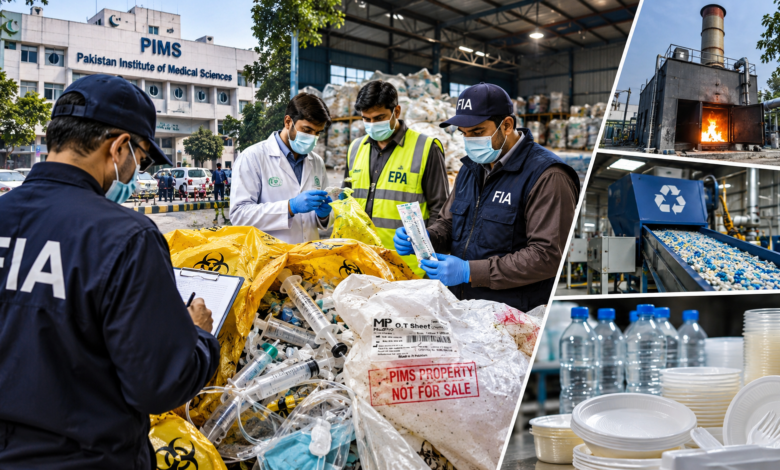
ISLAMABAD: The Federal Investigation Agency (FIA) Anti-Corruption Circle Islamabad has uncovered an alleged organised network involved in the unlawful sale, transportation and recycling of infectious medical waste originating from the Pakistan Institute of Medical Sciences (PIMS), raising serious questions about administrative oversight, hospital waste management and public health protection in the federal capital.
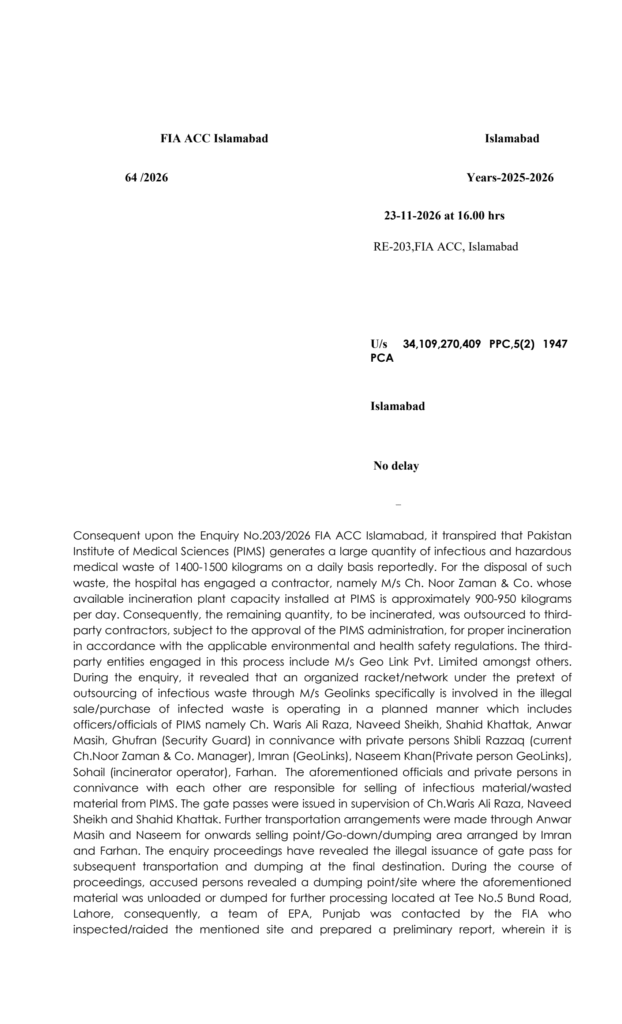
The agency has registered FIR No. 64/2026, dated November 23, 2026, following an investigation into alleged financial irregularities, violations of waste disposal contracts and the unauthorised commercial sale of hazardous medical material.
Eight suspects have reportedly been taken into custody, while efforts are underway to apprehend former PIMS Joint Executive Director (Non-Medical) Chaudhry Waris Ali Raza.
The investigation implicates hospital officials, sanitary workers, security personnel, private contractors and individuals allegedly associated with the transportation and disposal of infectious hospital waste.
How the Alleged Medical Waste Network Operated
According to the FIR, PIMS reportedly generates between 1,400 and 1,500 kilograms of infectious and hazardous medical waste every day.
However, the incineration facility installed at the hospital has a reported daily processing capacity of approximately 900 to 950 kilograms.
Consequently, an estimated 450 to 600 kilograms of waste requires additional treatment or disposal arrangements each day.
PIMS had engaged M/s Ch. Noor Zaman & Co. for medical waste disposal, while the remaining material was outsourced to third-party contractors, including M/s Geo Link Pvt Limited, subject to approval from the hospital administration.
The outsourced material was required to undergo appropriate treatment and disposal in accordance with environmental and health safety regulations.
However, FIA investigators allege that the outsourcing arrangement was exploited by an organised network to divert infectious hospital waste into commercial channels instead of ensuring its safe destruction.
The material reportedly included discarded syringes, masks, medical tubing and other plastic-based healthcare products.
Investigators allege that certain hospital officials and private individuals facilitated the removal, transportation and commercial sale of this material.
Hospital Gate Passes Under Investigation
The FIA inquiry has identified the alleged unauthorised issuance of hospital gate passes as a significant component of the suspected operation.
According to the FIR, gate passes facilitating the removal of medical waste were allegedly issued under the supervision of certain hospital officials.
The material was subsequently transported to locations arranged by individuals associated with private contractors.
Investigators are examining whether the hospital’s internal approval, security and documentation mechanisms were deliberately bypassed to facilitate the movement of infectious waste.
The inquiry has also examined financial transactions involving individuals and entities associated with the waste disposal arrangements.
According to the FIA, preliminary analysis identified payment arrangements allegedly linked to the commercial trading of infectious medical material.
These transactions are being investigated to establish individual responsibilities and determine whether public officials and private contractors financially benefited from the alleged operation.
Over 4.2 Tonnes of Medical Waste Recovered in Lahore
During the investigation, information obtained by the FIA led authorities to a warehouse located near Tee No. 5 on Bund Road, Lahore.
The FIA subsequently contacted the Punjab Environmental Protection Agency (EPA), whose team inspected the premises.
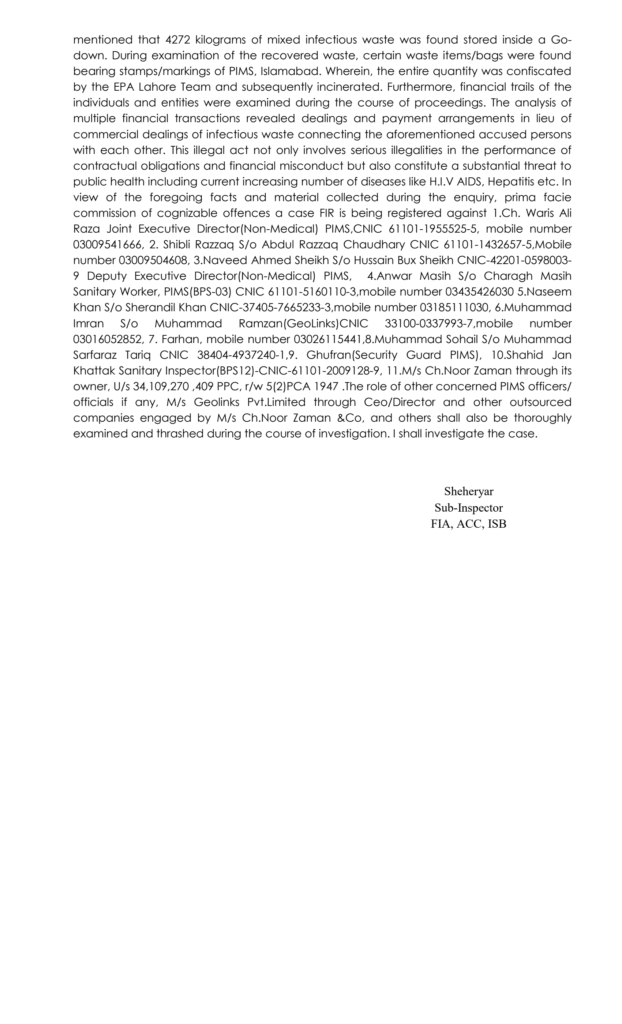
According to the preliminary findings cited in the FIR, approximately 4,272 kilograms of mixed infectious medical waste was recovered from inside the warehouse.
Some of the recovered items and bags reportedly carried stamps and identifying markings belonging to PIMS Islamabad, potentially establishing a connection between the material and the federal capital’s hospital waste disposal system.
Photographs supplied alongside the FIR show discarded medical packaging, including material bearing apparent PIMS property markings.
The recovered waste was reportedly confiscated by the Punjab EPA and subsequently destroyed through incineration.
Although initial media reports placed the recovered quantity at approximately 5,000 kilograms, the FIR specifically records 4,272 kilograms.
Former Senior PIMS Officials Among Those Named
The FIR names ten individuals and one contracting firm in connection with the investigation:
- Chaudhry Waris Ali Raza, Joint Executive Director (Non-Medical), PIMS.
- Shibli Razzaq, manager associated with Ch. Noor Zaman & Co.
- Naveed Ahmed Sheikh, Deputy Executive Director (Non-Medical), PIMS.
- Anwar Masih, sanitary worker, PIMS.
- Naseem Khan.
- Muhammad Imran, associated with GeoLinks.
- Farhan.
- Muhammad Sohail.
- Ghufran, security guard, PIMS.
- Shahid Jan Khattak, sanitary inspector.
- M/s Ch. Noor Zaman, through its owner.
The role of other concerned PIMS officials, the management of GeoLinks Pvt Limited and additional outsourced contractors will also be examined during the investigation.
Being named in an FIR does not establish criminal responsibility, and all individuals and entities remain entitled to the presumption of innocence unless proven guilty by a competent court.
Alleged Recycling Into Consumer Products
According to initial reports concerning the FIA investigation, discarded medical plastics were allegedly being diverted towards recycling operations rather than being safely treated and destroyed.
Investigators are reportedly examining whether some of this material entered manufacturing supply chains producing plastic crockery, water bottles and other consumer goods.
However, the supplied FIR does not identify specific manufacturing facilities, consumer brands, finished products or retail outlets.
The precise extent of the alleged recycling network, its commercial beneficiaries and whether affected products reached consumers remain matters requiring further investigation.
The allegations also raise questions about the traceability of industrial plastic materials and the regulatory oversight of recycling businesses handling potentially hazardous waste.
Health Risks and Disease Transmission
The FIA has expressed concern that the unlawful handling and commercial trading of infectious medical waste could pose substantial risks to public health.
Improperly handled healthcare waste can expose hospital employees, sanitary workers, waste collectors, recycling workers and members of the public to infectious material.
According to the World Health Organization, discarded sharps and contaminated medical equipment can transmit bloodborne infections, particularly through accidental injuries and direct exposure to infected blood.
Potential risks include hepatitis B, hepatitis C and HIV transmission under relevant exposure conditions.
The WHO estimates that approximately 15 percent of healthcare waste generated globally is hazardous, while the remaining 85 percent is generally non-hazardous.
However, there is currently no epidemiological evidence presented in the supplied FIR establishing that this particular PIMS operation caused an increase in HIV or hepatitis infections.
Similarly, ordinary contact with plastic products or drinking from water bottles is not an established route of HIV transmission. Any specific risk associated with recycled products would require scientific assessment of their contamination and processing conditions.
What Pakistan’s Hospital Waste Management Rules Require
Pakistan’s Hospital Waste Management Rules, 2005, establish requirements governing the segregation, collection, storage, transportation, treatment and disposal of hazardous healthcare waste.
The regulatory framework requires hospitals to maintain appropriate waste management arrangements and ensure that hazardous material is rendered safe through approved treatment methods before final disposal.
Hospitals are expected to maintain effective oversight of their waste management operations, including arrangements involving external service providers.
The alleged diversion of infectious medical material from approved disposal channels raises questions regarding PIMS’ compliance mechanisms, contractor supervision and internal administrative controls.
The reported difference between the hospital’s daily waste generation and its existing treatment capacity also highlights the importance of ensuring that outsourced waste remains traceable throughout the disposal process.
Criminal Proceedings and Financial Investigation
The FIA has registered the case under Sections 34, 109, 270 and 409 of the Pakistan Penal Code, read with Section 5(2) of the Prevention of Corruption Act, 1947.
The provisions cited in the FIR concern allegations relating to common intention, abetment, conduct likely to spread dangerous infections, criminal breach of trust and corruption-related misconduct.
Investigators are also examining the circumstances surrounding the awarding and execution of the hospital’s medical waste disposal contract.
Initial reports allege irregularities in the award of the contract to Ch. Noor Zaman & Co., although a definitive determination regarding procurement violations remains subject to investigation.
The case is being investigated by Sub-Inspector Sheheryar of the FIA Anti-Corruption Circle Islamabad.
Further developments are expected as the FIA investigation continues.