PM Sets December 31 Deadline for Nationwide Factory Tax Monitoring
Prime Minister Shehbaz Sharif orders nationwide expansion of automated industrial production monitoring by December 31 as officials report Rs1.3 trillion in additional tax collections through enforcement measures over three years.

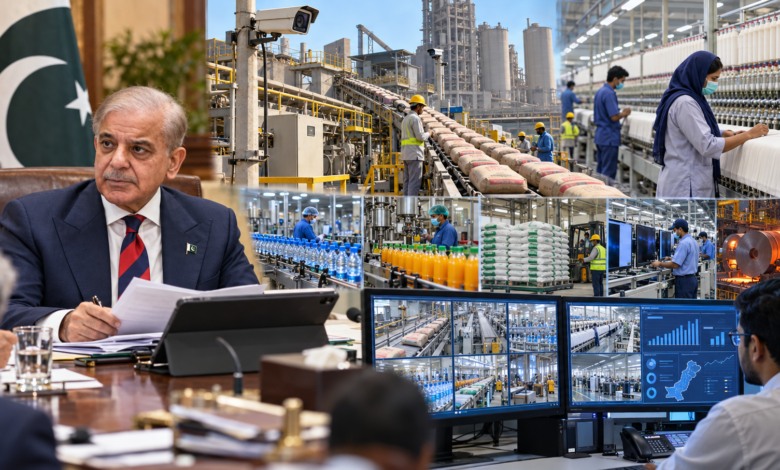
ISLAMABAD, October 12, 2026: Prime Minister Muhammad Shehbaz Sharif has directed the Federal Board of Revenue (FBR) to complete the installation and operationalisation of automated production monitoring systems across the identified manufacturing sectors by December 31, 2026, as part of the government’s efforts to strengthen sales tax collection and improve transparency in industrial reporting.
Chairing a review meeting on FBR reforms in Islamabad on Monday, the prime minister instructed the authorities to remove obstacles to the installation of camera-based monitoring equipment and accelerate the implementation of a technology-driven, faceless production verification system.
According to Prime Minister’s Office Press Release No. 424/2026, the meeting reviewed progress across major manufacturing industries, examined the difference between potential and actual tax collections, and assessed measures aimed at improving revenue mobilisation.
The prime minister said businesses that collect taxes from consumers but fail to deposit the corresponding amounts with the national exchequer should not receive preferential treatment.
He also appreciated manufacturers voluntarily adopting the government’s production monitoring framework.
Five Industrial Sectors Already Covered
During the briefing, officials informed the prime minister that production monitoring systems had been fully installed in five major manufacturing sectors.
These include sugar, cement, tobacco, tiles and fertilisers.
The monitoring framework is designed to capture manufacturing activity through automated equipment, allowing tax authorities to compare production volumes with declared sales and associated tax liabilities.
The government believes that direct monitoring of factory output will reduce discrepancies in reporting and improve the accuracy of sales tax assessments.
Monitoring Expansion Across Additional Industries
Officials presented a phased implementation schedule for extending electronic monitoring to other manufacturing sectors.
The meeting was informed that equipment procurement had been completed for the textile, packaged drinking water, packaged juice and packaged milk industries, with installation activities underway.
Procurement for the steel, poultry and tyre industries is scheduled to be completed by October 15.
Similarly, equipment procurement for packaged tea, household electronics, leather, paper and paperboard, and edible oil and ghee is expected to be completed by October 30.
The prime minister directed that all identified sectors be brought under fully operational production monitoring arrangements by December 31, 2026.
The deadlines relate to the government’s implementation schedule, and the completion of equipment procurement does not necessarily mean that monitoring systems have already become operational.
Leading Textile Companies Recognised for Voluntary Compliance
The meeting was also informed that implementation had encountered resistance from a number of textile manufacturers.
However, officials identified several textile businesses that had voluntarily installed production monitoring equipment in accordance with government requirements.
These included Nishat Mills, Alkaram Textile, Alkaram Cotton Mills, J.K. Spinning Mills, Soorty Enterprises, Interloop Limited, Faisal Spinning Mills, Ibrahim Fibres Limited, Sapphire Textiles Limited and Nishat Chunian.
Prime Minister Shehbaz Sharif praised the companies for cooperating with the monitoring initiative and supporting the government’s tax administration reforms.
He said businesses voluntarily implementing the system deserved recognition for their cooperation.
The official statement did not identify the individual factories reportedly resisting installation or provide details about specific compliance disputes.
Independent Technical Audits Ordered
The prime minister also reviewed an audit report concerning the effectiveness of the production monitoring system in the cement industry.
Appreciating the findings, he directed the Ministry of Information Technology and Telecommunication to conduct similar technical assessments of monitoring systems being implemented in other manufacturing sectors.
The proposed audits are intended to evaluate whether the installed technology effectively captures production information and supports reliable tax administration.
The direction also places emphasis on verifying the performance of monitoring equipment rather than relying solely on installation reports.
Government Reports Rs1.3 Trillion in Additional Revenue
A significant portion of the meeting focused on the difference between Pakistan’s estimated tax collection potential and the revenue actually being collected.
The FBR Transformation Team presented a comprehensive assessment of the country’s tax capacity, identifying the need for stronger collection mechanisms and improved compliance across economic sectors.
According to officials briefing the meeting, government enforcement measures generated an additional Rs1.3 trillion in tax collections over the preceding three years.
The briefing described the increase as representing approximately 40 percent growth in tax collection attributable to enforcement efforts.
However, the Prime Minister’s Office statement did not provide a detailed annual breakdown, the underlying calculation of the percentage increase, or independently audited figures supporting the estimate.
The prime minister appreciated the FBR Transformation Team for preparing the tax potential assessment after extensive research and analysis.
He said collecting taxes in accordance with the country’s actual revenue potential was essential for improving public services and strengthening national finances.
At the conclusion of the meeting, the prime minister presented recognition shields to members of the team responsible for preparing the assessment.
Digital Monitoring Forms Part of Broader FBR Reforms
The factory monitoring initiative is part of a wider effort to modernise tax administration through electronic verification, data integration and reduced reliance on manual reporting.
Pakistan’s existing Track and Trace System already provides a framework for monitoring goods in sectors such as sugar, tobacco, cement and fertilisers.
The government has been expanding electronic monitoring through video analytics and other technologies to obtain production data directly from manufacturing facilities.
Under recently announced FBR arrangements, authorised vendors may install internet-connected cameras and network video recording equipment on production lines. The monitoring framework is intended to improve visibility over actual factory output while maintaining regulatory controls over recorded information.
The effectiveness of the expanded programme will depend on equipment deployment, reliable data transmission, technical audits and sustained compliance by participating manufacturers.
Senior Ministers Attend Islamabad Meeting
The review meeting was attended by Federal Ministers Azam Nazeer Tarar, Dr Musadik Malik, Ahad Khan Cheema and Shaza Fatima Khawaja.
Minister of State Bilal Azhar Kayani, Adviser to the Prime Minister Haroon Akhtar and other senior government officials also participated.
The prime minister reiterated that the government would take the measures necessary to realise the country’s tax collection potential while recognising businesses that voluntarily comply with established requirements.
With December 31 established as the implementation deadline, the FBR faces a defined timeframe to complete equipment installations, address operational obstacles and verify the effectiveness of electronic production monitoring across the remaining identified sectors.
Source: Prime Minister’s Office, Media Wing, Press Release No. 424/2026, dated October 12, 2026. Additional background: Federal Board of Revenue regulatory material and reporting on electronic production monitoring.