Constitutional Court Rejects Police Officer’s Promotion Plea, Invokes Jinnah’s Principles
Court stresses that civil servants must resist political pressure and serve the state with integrity while dismissing PSP officer Tanveer Ahmed Tahir’s promotion petition.

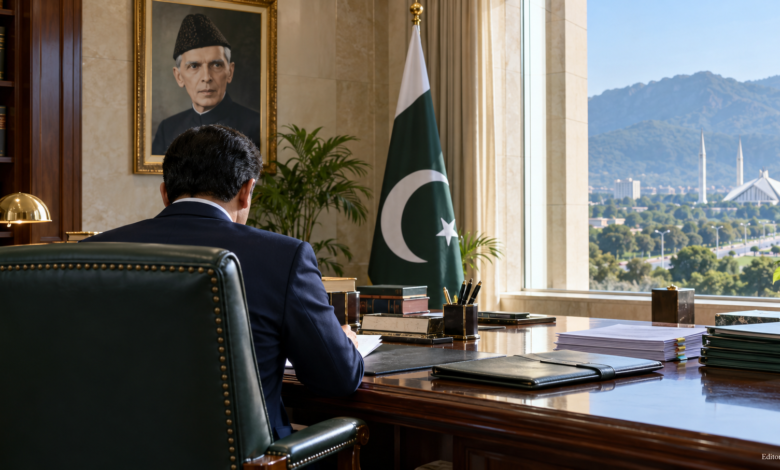
ISLAMABAD: The Federal Constitutional Court has dismissed the appeal filed by Police Service of Pakistan (PSP) officer Tanveer Ahmed Tahir against the denial of promotion from Basic Pay Scale (BPS) 19 to BPS-20, upholding the Islamabad High Court’s division bench judgment dated February 15, 2022. Justice Ali Baqar Najafi issued the written judgment, addressing the legal requirements for promotion, the authority of selection boards and the effect of pending criminal proceedings on promotion cases.
The judgment also referred to Quaid-e-Azam Muhammad Ali Jinnah’s historic address to civil officers in Peshawar in April 1948, highlighting the principles of political neutrality, integrity and service to the state and the public.
Quaid-e-Azam’s Guidance to Civil Servants
According to the judgment, Quaid-e-Azam emphasised that civil servants must not come under political pressure or the influence of political parties or politicians. The court recalled his statement that governments may come and go, but the civil service remains the backbone of the state.
The judgment also highlighted Quaid-e-Azam’s message that civil servants should serve the state and its people honestly and fearlessly. It further referred to his warning that political interference could give rise to serious problems, including corruption, bribery and nepotism.
The court’s reference to the historic address underscored the importance of political neutrality, integrity and professional responsibility in public service.
Background of the Promotion Dispute
Tanveer Ahmed Tahir passed the Central Superior Services (CSS) examination in 1999 and subsequently joined the Police Service of Pakistan. He was promoted to BPS-18 on June 22, 2007, and to BPS-19 on January 16, 2015.
According to the case details, his promotion was deferred in 2018 and 2019 following a conviction in a National Accountability Bureau (NAB) reference. The Sindh High Court acquitted him in that reference on November 8, 2019. Following his acquittal, he was reinstated in service on January 24, 2020.
In January 2020, the Central Selection Board reconsidered his promotion case during its fourth meeting. However, he was superseded because another NAB reference was pending against him. Meanwhile, some of his junior officers were promoted in 2020, while Tahir was not recommended for promotion.
He challenged the decision before the Islamabad High Court. Both the single bench and the division bench dismissed his case. The division bench’s judgment, delivered on February 15, 2022, upheld the decision regarding his non-promotion and the promotion of junior officers.
The high court held that the selection board had acted in accordance with the applicable rules and the Civil Servants Promotion Rules, 2019.
Arguments Presented by Farooq H. Naek
During the proceedings, counsel for the appellant, Farooq H. Naek, argued that Tahir had secured 74 per cent marks in the Senior Management Course (SMC), while his overall performance score stood at 76.5 per cent.
The counsel contended that the selection board had awarded the officer only 10 marks out of the 30 allocated to the board without providing a reasonable justification. He maintained that the officer had never received an adverse Performance Evaluation Report (PER) or Annual Confidential Report (ACR).
Naek further argued that an officer could not be superseded under the Civil Servants Promotion Rules, 2019, merely because a NAB reference remained pending. According to the counsel, the promotion of an officer should not be delayed because of departmental negligence or inaction.
He also maintained that junior officers with lower scores had been promoted while Tahir had been denied promotion despite his professional training results and performance record.
Court’s Findings on the Required Promotion Score
The Federal Constitutional Court noted that Tahir had received a total of 63.56 marks out of 70 after being awarded 10 marks by the selection board. His score was below the mandatory threshold of 70 marks required for promotion to BPS-20 under the Civil Servants Promotion Rules, 2019.
The court held that a government employee cannot claim promotion as an automatic right. However, a civil servant is entitled to have his promotion case considered in accordance with the law and the applicable rules.
The judgment also addressed the scope of judicial review of selection board assessments. The court observed that the marks awarded by a selection board and its objective assessment cannot ordinarily be reassessed by a court as though it were the competent promotion authority.
Acquittal Does Not Automatically End Departmental Proceedings
The judgment clarified the implications of acquittal in criminal proceedings for an officer’s promotion case. The court stated that if an officer is acquitted in a pending criminal reference, the promotion case should be reconsidered in accordance with the law.
However, the court also made clear that acquittal in a criminal case does not automatically terminate separate departmental disciplinary proceedings. Criminal proceedings and departmental action are governed by their respective legal requirements.
The judgment thus addresses both the requirement to consider promotion cases in accordance with the applicable rules and the distinction between criminal proceedings and departmental disciplinary action.