IHC gives Bari Imam House petitioner five days to submit ownership documents
CDA directed to hear the petitioner and issue a reasoned decision within two days of receiving the documents as court disposes of sealing petition without deciding ownership.

ISLAMABAD: The Islamabad High Court has directed the petitioner challenging the sealing of Bari Imam House in Nurpur Shahan to approach the Capital Development Authority within five days of receiving its order and submit any ownership documents supporting his claim to the land.
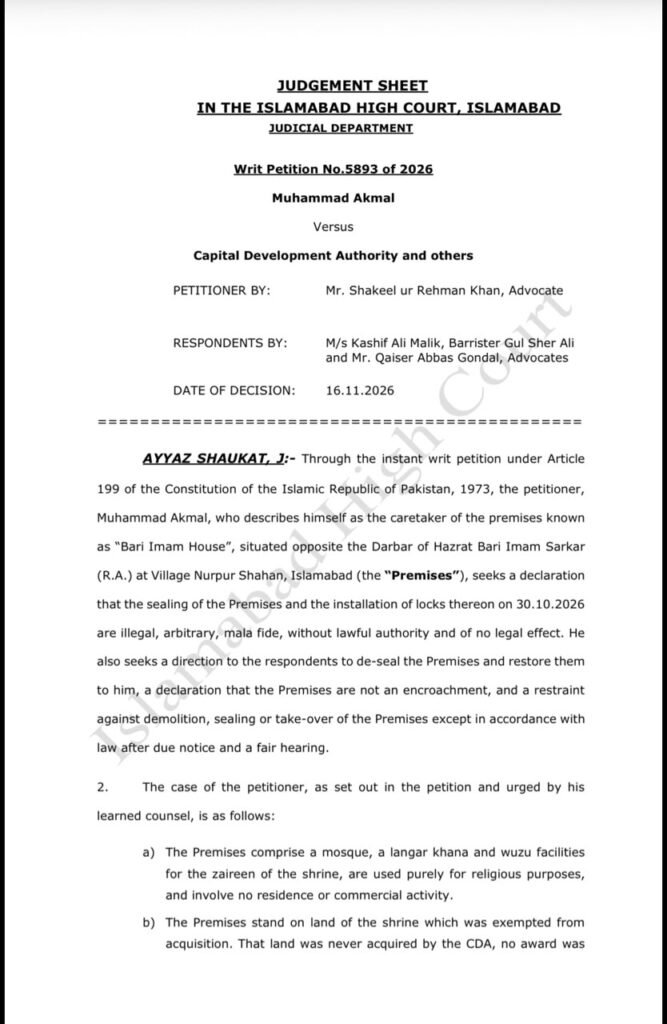
In a five-page judgment dated November 16, Justice Ayyaz Shaukat disposed of the petition with directions requiring the CDA to hear the petitioner, examine his documents alongside its own record and issue a reasoned written decision within two days of their submission.
The judgment requires petitioner Muhammad Akmal, who describes himself as the caretaker of the premises, to establish ownership and possession of the land on which the building stands. The khasra numbers identifying that land must correspond to those mentioned in the ownership documents on which he relies.
The court also made clear that its order expressed no opinion on the merits of either party’s title or possession. Anyone aggrieved by the CDA’s subsequent decision may pursue the remedy available under the law.
Five Days to Submit Documents and Two Days for a Decision
Under the court’s directions, Akmal must approach the CDA within five days from the date he receives the order and submit the ownership documents, if any, supporting his claim.
After giving him an opportunity of hearing, the authority must consider those documents together with its official record and decide the matter through a “speaking order” — a written decision setting out its reasons — within two days of submission. A copy must also be supplied to the petitioner.
If the petitioner does not wish to submit ownership documents or fails to do so within the stipulated period, the CDA will be at liberty to proceed in accordance with law.
The judgment therefore establishes a process for examining the competing claims. It does not itself direct immediate demolition or conclusively declare either side the lawful owner.
Court Records Absence of Ownership Documents
A central observation in the judgment concerns the evidence placed before the court.
Justice Shaukat recorded that the petitioner’s counsel was repeatedly asked to produce a document establishing ownership of, or title to, the premises or the underlying land.
According to the judgment, counsel conceded that the petitioner did not have ownership documents and said that any such documents were with the Islamabad Capital Territory administration and the CDA.
The court consequently noted that no document establishing ownership or lawful possession, or identifying the khasra numbers on which the premises stood, had been placed on record. It recorded that the documents annexed to the petition consisted of photographs of the premises.
The judge observed that the petitioner’s case rested on the assertion that the building stood on exempted shrine land that had never been acquired. The CDA disputed that position and relied on its acquisition and revenue records.
Resolving that disagreement required examination of the records and identification of the relevant parcels. On the material presented, the court said it could not declare the land exempted shrine property, declare the premises free of encroachment or recognise the petitioner’s entitlement to possession merely on unsupported assertions.
How the Dispute Reached the High Court
The petition, filed under Article 199 of the Constitution, challenged the sealing and installation of locks at the premises on October 30, 2026.
The building described as Bari Imam House is situated opposite the shrine of Hazrat Bari Imam Sarkar in Nurpur Shahan, Islamabad.
Akmal maintained that the premises comprised a mosque, a langarkhana and ablution facilities for visitors to the shrine. According to his petition, the site was used exclusively for religious purposes and involved no residential or commercial activity.
He claimed that the underlying land belonged to the shrine, was exempt from acquisition and had never been acquired by the CDA. He also maintained that no acquisition award had been announced or compensation paid for that land, and that the caretakers had remained in longstanding peaceful possession.
The petitioner alleged that officials sealed the premises and installed an Auqaf Department board at the entrance without notice, a written order or an opportunity of hearing. He challenged the action on constitutional grounds and sought removal of the seals, restoration of the premises and protection against further action except through lawful procedure.
These were the petitioner’s submissions, rather than findings accepting his ownership claim.
CDA Relies on 1963 Acquisition Record
The CDA contested both the petitioner’s entitlement and the claim that the disputed property formed part of exempted shrine land.
As recorded in the judgment, the authority maintained that the land had been acquired under Award No. 4/DC CDA/1963 and that the landowners had been compensated.
It identified the disputed parcels as Khasra Nos. 435, 582, 591, 592 and 593. The authority said its acquisition record contained no reference to a building or establishment called Bari Imam House and that it did not recognise the petitioner as its lawful custodian.
The CDA separately identified the shrine land as Khasra Nos. 277, 665, 677, 678, 679 and 680, recorded in the name of Darbar Aalia Hazrat Bari Abdul Latif Shah.
According to the authority, those parcels lie across the road and are distinct from the acquired land occupied by the disputed premises.
On that basis, the CDA argued that the building did not form part of the shrine property and that its occupation amounted to encroachment. It also questioned the petitioner’s legal standing and argued that the disputed factual issues could not be resolved in constitutional proceedings.
The judgment recounts these arguments without making a final determination of title in the CDA’s favour.
Earlier De-Sealing Order Merged into Final Judgment
On November 3, the High Court issued notices to the respondents and directed them to submit reports and paragraph-wise comments within two weeks.
Through an interim order, it also directed officials to immediately de-seal the premises and refrain from further demolition until the next hearing.
The CDA subsequently sought an early hearing. That request was allowed on November 12, bringing the case before the court for the November 16 decision. Contemporary reporting also recorded that the authority was seeking vacation of the earlier stay.
The final judgment states that the November 3 interim order stands merged into the new order. The earlier relief must therefore be read in the context of the final directions, rather than presented as an indefinite, separate stay.
Opportunity of Hearing Remains Essential
While recording the lack of ownership evidence before it, the court also addressed the petitioner’s complaint that the sealing had taken place without notice or a hearing.
Justice Shaukat observed that both that grievance and the CDA’s objection to the petitioner’s title could be addressed through a fair and prompt determination based on documents.
As a statutory authority, the CDA must act strictly according to law and give the petitioner an opportunity to establish his claim before taking coercive action, the judgment states. The petitioner, in turn, must establish his entitlement.
The court disposed of the petition and pending miscellaneous applications with these directions, leaving the documentary assessment to the CDA and preserving the right to challenge its eventual decision through the remedies available under law.