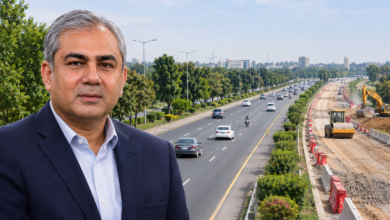
Naqvi Slams Slow Progress on Margalla Road Extension
Interior minister orders additional manpower and machinery, seeks daily progress reports and questions the December 31 deadline, as the project lags behind the pace of several infrastructure schemes completed during his tenure.


ISLAMABAD: Federal Interior Minister Mohsin Naqvi has expressed strong displeasure over the slow pace of construction on the Margalla Avenue extension to the M-1 Motorway and the Sangjani Interchange project, directing authorities to immediately increase manpower and deploy additional machinery.
During an inspection of the construction site on Thursday, the interior minister expressed dissatisfaction with the resources deployed and questioned whether the project could be completed within the stipulated deadline of December 31, 2026.
Naqvi remarked that if construction continued at the existing pace, the project might not be completed even within the next six months.
The minister observed that a single machine and a handful of workers were insufficient for a development project of such scale.
He directed the concerned authorities to accelerate construction activities, increase the workforce and ensure the availability of adequate machinery at the site.
Naqvi also sought daily progress reports and announced that he would revisit the construction site after seven days to personally assess improvements in the pace of development.
Only 43 Percent of Construction Completed
The minister’s dissatisfaction comes just three days after the Capital Development Authority (CDA) reported that 43 percent of the development work on the Margalla Avenue extension and Sangjani Interchange project had been completed.
According to official CDA progress updates, overall construction stood at 35 percent on November 8, increased to 36 percent on November 13, reached 41 percent on November 17 and subsequently rose to 43 percent on November 23.
Although the civic authority maintained that construction activities were continuing around the clock across different sections of the project, Naqvi’s latest inspection has raised fresh questions regarding the feasibility of completing the remaining work before the end of December.
Islamabad’s Fast-Track Infrastructure Development Under Naqvi
The interior minister’s dissatisfaction is particularly significant given the accelerated construction schedules adopted for several major infrastructure projects in Islamabad since he assumed office in March 2024.
During his tenure, the federal capital has witnessed the completion of several major road infrastructure projects aimed at addressing traffic congestion, improving urban mobility and modernising the city’s transport network.
Among the most notable developments was the Serena Chowk Interchange, also known as the Jinnah Square project, which was completed in 72 days, according to the Ministry of Interior.
The project comprised three underpasses and connecting roads, improving connectivity around Constitution Avenue, Srinagar Highway, the Diplomatic Enclave and the Convention Centre.
Similarly, the underpass at F-8 Exchange Chowk was completed in 42 days, while the entire Recep Tayyip Erdoğan Interchange project, comprising an underpass, flyover and supporting road infrastructure, was completed in 85 days, according to project consultant NESPAK.
Another significant development was the Shaheen Chowk Underpass on Margalla Road at its intersection with Ninth Avenue. The project was completed in 63 days and opened to traffic around the beginning of 2026, considerably ahead of its original 150-day construction schedule.
Other infrastructure schemes completed during Naqvi’s tenure include the T-Chowk Flyover, Murree Road Underpass and Park Road improvement project.
Beyond road infrastructure, the capital also witnessed the completion of the Business Facilitation Centre.
In his year-end assessment of Islamabad’s development activities, Naqvi stated that the CDA had completed 18 development projects worth approximately Rs15 billion during 2025.
Several of these projects involved frequent ministerial inspections, round-the-clock construction operations and accelerated completion targets.
While the scope and engineering requirements of individual projects differ, their reported construction schedules provide important context for the interior minister’s latest directives concerning the Margalla Avenue extension.
Project Scope and Construction Status
The development scheme includes an approximately 2.7-kilometre extension of Margalla Avenue within Islamabad Capital Territory, along with an interchange, an underpass, bridges, connecting service roads, ramps and supporting infrastructure.
The CDA’s November 23 update indicated that the structural work on the underpass had been completed, while earth-filling operations remained underway.
Foundation and girder-related work on key structures had also progressed, alongside ongoing steel reinforcement and other construction activities.
Four of the project’s five culverts had been completed, while construction of interchange loops and ramps had reached advanced stages.
Strategic Importance for Islamabad
The Margalla Avenue extension is an important infrastructure initiative aimed at establishing an alternative connection between Islamabad and the M-1 Motorway through the Sangjani area.
Once operational, the route is expected to improve motorway accessibility for residents of Islamabad’s northern sectors, reduce dependence on existing major transport corridors and potentially ease traffic pressure on Srinagar Highway.
The project is also expected to facilitate commuters travelling between Islamabad and Khyber Pakhtunkhwa, while improving connectivity to Islamabad International Airport.
Unlike previous urban interchange projects, the Margalla Avenue extension involves broader highway connectivity and multiple engineering components, making coordinated execution across different sections particularly important.
December Deadline Faces Fresh Uncertainty
With approximately five weeks remaining until the December 31 deadline and 57 percent of the development work outstanding according to the latest CDA figures, the project faces a demanding construction schedule.
The interior minister’s decision to seek daily progress reports, increase construction resources and revisit the site within seven days reflects renewed administrative pressure to accelerate its completion.
Whether the authorities can reproduce the accelerated construction schedules achieved on several previous infrastructure projects will depend on the effective mobilisation of resources, engineering requirements and progress across the remaining sections.