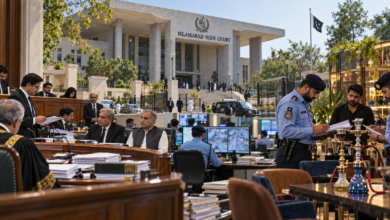
Islamabad High Court Strikes Down Land Transfer Ban in Shah Allah Ditta, Sangjani & Sarai Kharbuza


ISLAMABAD: In a significant judgment protecting citizens’ constitutional property rights, the Islamabad High Court (IHC) has declared the administrative ban on the sale, registration, and transfer of land in Shah Allah Ditta, Sarai Kharbuza, and Sangjani illegal, ruling that executive authorities cannot suspend lawful property transactions without clear legal authority.
Justice Muhammad Asif announced the verdict while allowing a petition filed by resident Fazal Abbas, challenging the restrictions imposed on land registration and mutation in the affected areas.
In its detailed written judgment, the court directed all relevant authorities to process property registrations and land transfers strictly in accordance with the law and the prescribed legal procedure.
The court observed that the government cannot deprive law-abiding citizens of their constitutional property rights under the pretext of preventing illegal housing schemes. It held that the blanket restriction imposed on the basis of a CDA communication had no legal foundation.
The judgment further ruled that verbal instructions issued by the Deputy Commissioner Islamabad to sub-registrars and revenue officials to halt registrations and mutations were beyond the scope of the law. According to the court, the administration unlawfully expanded the scope of an earlier High Court order, which had only prohibited illegal housing schemes and related construction activities, not legitimate property transactions.
Justice Asif emphasized that executive authorities are bound to implement judicial orders exactly as issued and cannot alter or expand them through administrative directions.
The court also held that neither the CDA Ordinance, 1960, nor the Islamabad Zoning Regulations, 1992, grant the Deputy Commissioner any legal or discretionary authority to freeze private property transactions.
Referring to Articles 23 and 24 of the Constitution, the judgment stated that citizens have a fundamental right to acquire, hold, transfer, and dispose of property, and any administrative action affecting those rights must have explicit legal backing.
The court observed that imposing a complete ban on land transfers across entire localities, instead of taking action against actual violators, amounted to discriminatory treatment. It further noted that under the principle of proportionality, authorities should adopt measures that least restrict citizens’ fundamental rights while addressing illegal housing schemes.
Highlighting the petitioner’s circumstances, the court noted that Fazal Abbas, a permanent resident of Shah Allah Ditta, had been unable to sell or transfer his property to arrange medical expenses for his mother, who is undergoing treatment for a kidney illness. The judgment described the hardship caused by the restrictions as unjustified, adding that the affected citizens were neither served notices nor given an opportunity to be heard before the ban was enforced.
However, the court clarified that the ruling does not prevent the CDA or other competent authorities from taking legal action against illegal housing schemes. It reaffirmed that authorities retain full powers to enforce the Islamabad Master Plan, zoning regulations, and demolition of unlawful constructions, provided such actions are taken through due legal process.