Syed Ali Nasir Rizvi Takes NCCIA Charge, Orders Cyber Crackdown
Former Islamabad police chief holds first nationwide meeting with senior NCCIA officers, directing intensified cyber patrols, action against illegal call centres, online harassment and gambling-related platforms, while introducing daily performance monitoring.

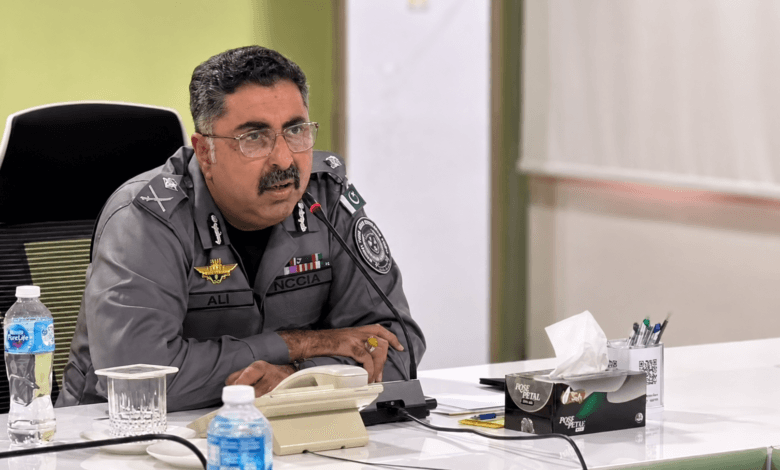
ISLAMABAD: Syed Ali Nasir Rizvi has formally assumed charge as Director General of the National Cyber Crime Investigation Agency (NCCIA), beginning his tenure with a nationwide meeting of the agency’s senior officers and outlining enforcement, accountability and public-access priorities.
Rizvi’s assumption of office follows his transfer from the post of Inspector General of Islamabad Police. The federal government appointed the BS-20 Police Service of Pakistan officer as DG NCCIA under Section 29(3) of the Prevention of Electronic Crimes Act, 2016, as amended in 2025. The NCCIA’s official website now also identifies Rizvi as its Director General.
Soon after taking charge, Rizvi held a meeting with NCCIA directors, additional directors, deputy directors and assistant directors serving across Pakistan, according to details shared regarding the meeting.
Rizvi Directs Action Against Cybercrime, Illegal Online Activity
During the briefing, the new DG directed officers to take legal action, in accordance with applicable law, against cybercrime and unlawful online activity. He particularly highlighted cases involving online harassment of women and the use of abusive or objectionable material targeting women on social-media platforms.
Rizvi also directed the agency to intensify action against illegal call centres, skimming-related offences, unlawful online operations and gambling-related applications and networks. He warned that officials who fail to act against illegal call centres within their jurisdictions would also face internal accountability where negligence or wrongdoing is established.
The NCCIA’s official mandate includes investigating cyber offences, directly receiving complaints and taking legal measures under the Prevention of Electronic Crimes Act. Its stated services include cyber investigations and digital forensics.
Internal Accountability and Cyber Patrolling
Internal accountability was another major focus of Rizvi’s first directives. He told officers that corruption and dishonesty would not be tolerated and that officials found involved in wrongdoing would face departmental action.
The DG also ordered enhanced monitoring of officers’ performance, with work to be reviewed on a 24-hour basis and official output linked to performance appraisal.
Cyber patrolling is also to be intensified, with officers directed to monitor social-media platforms and other online spaces for suspected criminal activity and pursue cases under the relevant legal framework. Pending investigations have been ordered to be disposed of expeditiously.
Rizvi also announced steps aimed at making NCCIA more accessible to citizens. According to the briefing details, work is underway to establish connectivity with the nationwide emergency helpline 15 so that cybercrime-related calls received there can be routed to NCCIA.
Universal contact numbers are also planned for public access. NCCIA’s official website currently lists 1799 as a contact number for its headquarters and several regional offices.
On content described by officials as false propaganda or anti-state online activity, Rizvi directed officers to act where conduct falls within applicable cybercrime laws. Given the legal and constitutional questions that can arise around online expression, individual cases would ultimately depend on their facts, the relevant statutory provisions and judicial scrutiny.
Rizvi previously served as Islamabad’s police chief from 2024 until his transfer this month. His appointment as NCCIA director general formed part of a senior-level reshuffle in which Capt (retd) Muhammad Sohail Chaudhry was appointed the new IGP Islamabad.