Three nations to determine operationalisation of Makkah defence pact: ISPR DG
DG ISPR says the Makkah Defence Agreement between Pakistan, Saudi Arabia and Turkiye is defensive in nature, with the three countries to decide how to respond if any partner comes under attack.

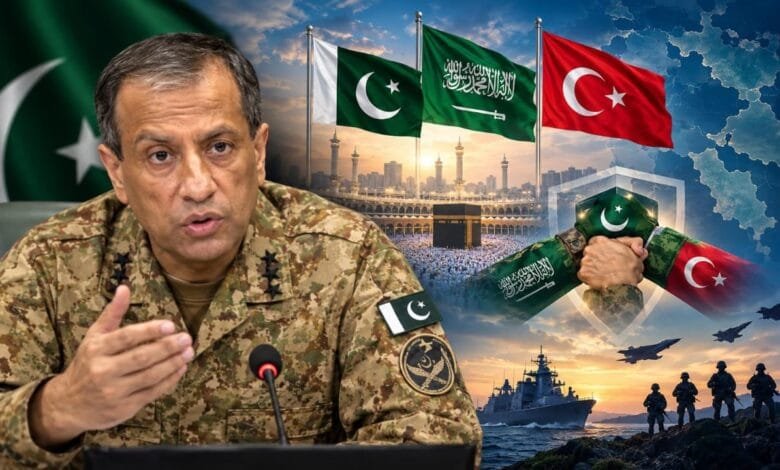
RAWALPINDI: Inter-Services Public Relations (ISPR) Director General Lieutenant General Ahmed Sharif Chaudhry has said Pakistan, Saudi Arabia and Turkiye will decide how to operationalise their defence commitments under the Makkah Joint Defence Agreement.
Speaking in an interview with Al Arabiya English, the ISPR chief described the trilateral agreement as defensive in nature, saying it had no “regional aspirations” and was aimed at collective deterrence.
The Makkah Joint Defence Agreement, signed by Pakistan, Saudi Arabia and Turkiye on August 7, provides a framework for collective security and defence cooperation among the three countries.
Asked how Pakistan would respond if any member of the pact came under attack, Lt Gen Chaudhry said the operational details of the agreement were classified.
He said the three countries would decide how the commitments would be implemented, adding that military agreements generally do not publicly disclose their operational procedures.
The ISPR DG also described the pact as “complementary” to the existing relationships of the three countries with other alliances, countries and blocs, stressing that it was not intended to compete with those relationships.
Conflict With India
Commenting on the May 2025 military confrontation between Pakistan and India, Lt Gen Chaudhry said a military conflict between two nuclear-armed neighbouring countries was “out of the question”.
He said Pakistan had demonstrated its capabilities across multiple domains during the confrontation, including the air, ground, cyber, maritime, informational and diplomatic spheres.
The ISPR chief said Pakistan’s position remained focused on regional peace, describing Islamabad as a “rational and objective” actor that believed in peace on equal terms.
However, he warned that Pakistan would respond to any military aggression aimed at its security and territorial integrity.
He also referred to the possibility of a “false flag operation” followed by an attempt to build a narrative and escalate tensions, warning that such a course could have severe consequences.
On mechanisms to prevent a future Pakistan-India confrontation from escalating to the nuclear level, Lt Gen Chaudhry said Pakistan’s military capability and resolve were a deterrent against such escalation.
He further said Pakistan’s political leadership had acted rationally during the May 2025 conflict, while claiming that India’s decision to pursue a military response had contributed to the escalation.
The May 2025 confrontation followed an attack in Pahalgam in Indian Illegally Occupied Jammu and Kashmir on April 22, 2025. India launched military strikes against Pakistan on May 7, while Pakistan subsequently carried out retaliatory operations.
The confrontation ended with a ceasefire on May 10 following diplomatic efforts led by the United States.