IHC Summons Top Islamabad Officials Over Illegal Sheesha Cafes
Chief Justice Sarfraz Dogar seeks assurances against unregulated cafe operations as Islamabad Police reports 89 cases involving 282 individuals and defends its enforcement record.

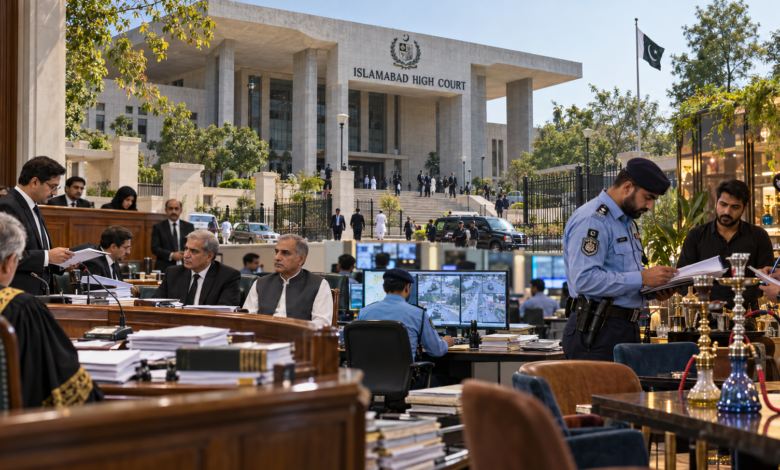
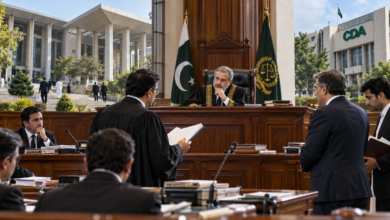
ISLAMABAD, October 13, 2026: The Islamabad High Court (IHC) has summoned the Chief Commissioner and Deputy Commissioner Islamabad to appear before the court at 2pm on Tuesday in a case concerning illegal sheesha cafes, with Chief Justice Sardar Muhammad Sarfraz Dogar expressing serious concern over the continued operation of establishments without a comprehensive regulatory framework.
During the hearing, the chief justice questioned how sheesha cafes were operating in the federal capital despite the absence of formally approved regulations. He indicated that the court could consider temporarily closing all sheesha cafes until the government finalises the applicable rules.
The chief justice directed the Chief Commissioner and Deputy Commissioner to appear personally and provide undertakings ensuring that illegal sheesha cafes would not be allowed to operate in Islamabad.
He observed that the court would consider issuing appropriate directions after receiving assurances from both officials.
Chief Justice Questions Interpretation of Earlier Order
During the proceedings, Chief Justice Sarfraz Dogar expressed displeasure over what he described as an incorrect interpretation of the court’s previous directions.
He clarified that the court had only intended to protect establishments operating in accordance with the law, rather than grant blanket permission for sheesha cafes to operate without regulatory oversight.
The chief justice observed that a particular paragraph from the previous order had been presented as though the court had permitted unrestricted sheesha operations.
He questioned how permission could be granted when the necessary rules and regulations had not been finalised.
The court also expressed concern that the misinterpretation had created a misleading public impression about its position.
Temporary Closure of Sheesha Cafes Under Consideration
During the hearing, the petitioner’s lawyer requested that all sheesha cafes be closed until the government finalises the regulatory framework.
The chief justice observed that temporary closure could be considered, with the position of establishments reviewed once the applicable rules were approved.
He also questioned the administration’s earlier decision to permit cafe operations without comprehensive regulations.
The court discussed the argument that closing cafes could affect employment and business activity. However, the chief justice emphasised the need to consider public health, particularly the welfare of younger citizens.
He further observed that the government should introduce appropriate standard operating procedures if formal rules could not be finalised promptly.
Government counsel informed the court that draft rules concerning sheesha cafes had already been prepared and forwarded to the government for approval.
Islamabad Police Submits Enforcement Report
Separately, the Inspector General of Islamabad Police submitted a detailed report defending the department’s actions against illegal sheesha cafes and narcotics-related activities.
According to the police response, allegations made by the petitioner regarding police negligence, inaction and failure to perform statutory duties were baseless and inconsistent with the enforcement record.
The report provided statistics covering action taken before and after the court’s intervention.
According to the submitted figures, 28 cases were registered at 10 police stations between January 1 and July 15, 2026, involving 119 individuals accused of violations associated with sheesha activities.
During the subsequent period, from July 16 to September 7, 2026, police registered 61 additional cases across 13 police station jurisdictions, involving 163 individuals.
Combined, the two reporting periods account for 89 registered cases and 282 individuals named or proceeded against in connection with the reported violations.
These figures represent police-reported cases and enforcement proceedings, not convictions established by a court.
Special Teams and Intelligence-Based Monitoring
The police informed the high court that dedicated teams had been established at police station and sub-divisional levels to monitor sheesha cafes and identify establishments operating in violation of applicable laws.
Special Branch and the District Intelligence Branch (DIB) have also been tasked with collecting information about existing and newly established sheesha cafes across Islamabad.
According to the police report, intelligence-based patrolling has been increased around educational institutions, student hostels, parks, bus stands and other locations considered sensitive from a public-safety perspective.
The police further stated that covert compliance checks, including decoy operations, were being conducted to identify unlawful activities.
Safe City Surveillance and Public Reporting
The IGP’s response also outlined measures aimed at improving surveillance and public reporting.
According to the report, CCTV cameras installed at commercial establishments are being integrated with the Safe City system to strengthen monitoring capabilities.
The police stated that the 4C Centre was being used for centralised monitoring and coordination of operations involving sheesha cafes.
Citizens can also report suspected illegal cafe operations through the Islamabad Police 1INFO application and other established reporting channels.
The report maintained that these initiatives demonstrate the department’s continuing enforcement activities rather than the alleged inaction cited by the petitioner.
Police Cite Zero-Tolerance Policy
The police response reiterated that Islamabad Police was pursuing a zero-tolerance approach towards illegal sheesha cafes and narcotics-related offences.
It also referred to the “Nasha Ab Nahi” public awareness campaign, launched on April 26, 2024, as part of broader preventive efforts.
The department stated that enforcement, intelligence gathering, surveillance and public awareness initiatives were being undertaken simultaneously.
On these grounds, the IGP requested the high court to reject the allegations of negligence and dispose of the petition.
Previous Court Order and Regulatory Uncertainty
The proceedings follow earlier directions issued by the Islamabad High Court in September 2026, when the administration was instructed to finalise regulations governing sheesha cafes within one month.
In its earlier written order, the court clarified that establishments operating lawfully under valid permissions should not face coercive action merely for carrying out permitted business activities.
At the same time, the court directed authorities to continue lawful enforcement against illegal sheesha operations and related offences.
The earlier proceedings also highlighted that the Prohibition of Sheesha Smoking Rules, 2023, remained pending before the federal government.
The latest hearing has brought renewed attention to the distinction between protecting lawful businesses and allowing establishments to operate without an effective regulatory framework.
Court Awaits Senior Officials’ Assurances
As the proceedings continued, Chief Justice Sarfraz Dogar directed the Chief Commissioner and Deputy Commissioner Islamabad to appear at 2pm and provide assurances concerning the operation of illegal sheesha cafes.
The court indicated that further directions would be considered after hearing the officials.
No final decision ordering the closure of all sheesha cafes had been established in the proceedings reported up to that stage.
The matter remains significant for the Islamabad administration, police authorities, cafe operators and residents as the capital awaits a definitive regulatory framework for sheesha businesses.