CDA Ranks Third in National Corruption Risk Assessment
NAB-led assessment flags six major vulnerabilities in Islamabad’s civic authority, including irregular plot allotments, procurement weaknesses, non-transparent auctions and conflicts of interest; 396 reforms proposed across federal institutions.

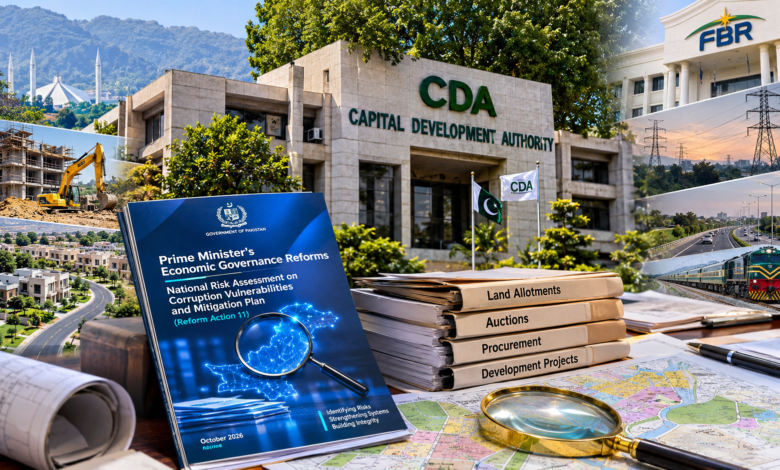
ISLAMABAD: The Capital Development Authority (CDA) has emerged as the third most vulnerable federal public-sector entity to corruption risks in Pakistan, according to the government’s National Risk Assessment on Corruption Vulnerabilities and Mitigation Plan 2026.
The assessment, conducted under the Prime Minister’s Economic Governance Reforms with the National Accountability Bureau (NAB) as its technical lead, examined 25 federal entities, identifying institutional weaknesses, financial management deficiencies, procurement risks and gaps in transparency and accountability.
Electricity distribution companies (DISCOs) topped the national rankings with a risk score of 61.1, followed by the Federal Board of Revenue (FBR) with 54.4 points and CDA with 49.5 points.
CDA was placed in the substantial-risk category, moving from fifth position in the preliminary screening to third in the detailed assessment.
The report highlighted weaknesses in CDA’s documented institutional safeguards, financial controls, land management, procurement procedures and regulatory framework, identifying six major patterns of corruption vulnerability within the authority.

CDA Records Second-Highest Procurement Red Flags
According to the assessment, the National Highway Authority (NHA) recorded the highest number of procurement red flags at 34, followed by CDA with 24.
The report identified concerns surrounding direct contracting at higher rates, variation orders issued without competitive bidding and contracts awarded to firms lacking the required experience.
Such weaknesses, the assessment noted, could increase development costs, undermine competition and create opportunities for preferential treatment of contractors.
The report also highlighted risks associated with advance payments without bank guarantees, unverified contractor payments, unsupported price adjustments, non-recovery of contractual penalties and failure to enforce financial safeguards in cases of abandoned development projects.
Irregular Plot Allotments and Amenity Land Conversion
Land management emerged as another major area of concern for Islamabad’s civic authority.
The assessment identified suspected irregular plot allotments, potential illegal conversion or sale of amenity plots, irregular approval of layout plans, incomplete compensation records and delays in handing over possession.
It recommended publishing complete details of plot allotments, including their categories and legal basis, alongside a sector-wise inventory of amenity plots and their approved purposes.
The report also called for a review of CDA’s employee plot-allocation arrangements to ensure transparency, financial sustainability and clearly defined eligibility criteria.
Completion of land-record digitisation, reconciliation of ownership documents and satellite-based monitoring of encroachments were among the proposed measures to strengthen the protection of public land in the federal capital.
CDA’s Dual Role Creates Conflict of Interest
One of the most significant structural concerns identified in the report is CDA’s simultaneous role as Islamabad’s development authority, land seller and regulatory body.
While CDA regulates private and cooperative housing societies, approves layout plans and takes action against illegal housing schemes, it also develops residential sectors and sells plots in direct competition with private developers.
The assessment warned that this institutional arrangement creates an inherent conflict of interest, particularly when the authority’s financial requirements depend heavily on land sales.
Regulatory decisions concerning housing societies, land-use conversions, allotments and building control could consequently be influenced by revenue considerations rather than independent planning standards.
The report recommended separating CDA’s regulatory and planning functions from its commercial, development and estate-management operations.
It further proposed establishing an independent committee to decide land-use conversions and allotments, separate from departments responsible for land sales and revenue generation.
Non-Transparent Auctions and Revenue Leakage
The assessment also identified vulnerabilities relating to commercial property auctions, unrecovered rents, non-imposition of penalties and unauthorised collection of parking fees.
Limited public disclosure of land sales, revenue sources and the utilisation of auction proceeds was identified as a major transparency concern.
The report recommended that CDA publish details of all land sales, auctions, land-use conversions, associated revenues and the utilisation of proceeds.
It also proposed introducing transparent online auction mechanisms, digital parking tickets, cashless payment systems, independent property valuations and automated monitoring of outstanding rent and penalties.
Financial Management and Possible CDA Restructuring
Weak reconciliation of cash, electricity and expenditure records, alongside concerns regarding the investment of surplus funds, were also highlighted in the assessment.
The report proposed strengthening internal audit mechanisms, introducing integrated financial management systems and ensuring regular reconciliation of bank accounts and expenditure records.
In the longer term, the government has been advised to consider restructuring CDA, with its primary responsibilities potentially becoming regulatory and planning-oriented.
Selected municipal and operational functions could be transferred, outsourced or privatised, subject to legal assessment, financial feasibility, public-interest considerations and effective oversight.
The assessment also recommended reducing CDA’s dependence on plot sales to finance recurring expenditure and developing sustainable revenue sources through municipal services, rents, property assets and regulatory fees.
Pakistan’s Top 10 Institutions by Corruption Risk
The final national assessment identified the following ten entities with the highest relative corruption-risk scores:
| Rank | Institution | Score | Risk Category |
|---|---|---|---|
| 1 | DISCOs | 61.1 | High |
| 2 | FBR | 54.4 | Substantial |
| 3 | CDA | 49.5 | Substantial |
| 4 | PASSCO | 47.1 | Substantial |
| 5 | NHA | 43.4 | Moderate |
| 6 | Pakistan Railways | 41.1 | Moderate |
| 7 | BISP | 40.1 | Moderate |
| 8 | Pakistan Post | 39.9 | Moderate |
| 9 | SNGPL | 39.3 | Moderate |
| 10 | ETPB | 39.3 | Moderate |
Of the 25 entities assessed in detail, only electricity distribution companies were classified in the high-risk category, while three institutions fell into the substantial-risk category, 14 into the moderate-risk category and seven into the low-risk category.
No institution was placed in the very high or extremely high-risk categories.
Governance Weaknesses Across Federal Institutions
The report identified recurring vulnerabilities across multiple sectors, including electricity distribution, taxation, highways, railways, gas supply, social welfare programmes, agricultural storage and public property management.
Non-transparent procurement emerged as a common risk across all ten highest-ranked entities, while nine faced vulnerabilities associated with revenue leakage and weak financial reconciliation.
Seven entities were found to have vulnerabilities associated with potential misappropriation of resources, while four faced risks related to land and property management.
Electricity distribution companies recorded the highest law-enforcement risk indicators, while FBR’s ranking was largely attributed to the scale of its revenue administration responsibilities and financial exposure.
Other institutional concerns included weaknesses in highway contracting, railway land management, wheat storage, gas distribution, welfare-payment verification and public asset protection.
Government Proposes 396 Corrective Measures
The national assessment identified 56 entity-specific corruption-risk patterns, 10 common governance vulnerabilities and 18 regulatory and ministerial risk patterns.
A comprehensive mitigation plan comprising 396 individual measures across 74 reform blocks has been proposed to address these weaknesses.
The recommendations include merit-based appointments, digitisation of government records, stronger procurement oversight, independent performance audits, improved inter-agency coordination and transparent management of public assets.
Implementation is proposed in three phases, with short-term measures covering up to two years, medium-term reforms spanning two to five years and long-term structural and legislative reforms extending beyond five years.
A National Mitigation Monitoring Committee, convened by the Minister for Law and Justice, will oversee implementation, with quarterly institutional progress reporting and biannual reporting to the prime minister.
The report explicitly clarifies that the rankings measure institutional vulnerability to corruption risks rather than established corruption or criminal misconduct.
The identified weaknesses are intended to guide preventive reforms, institutional restructuring and stronger accountability mechanisms and do not constitute findings of wrongdoing against any institution or individual official.