No Race for Records: Kashmir Chowk Needs Strong Construction
Islamabad journalist Saqib Bashir urges authorities to prioritise durability over record completion as CDA targets just one month for the Rs1.4 billion Kashmir Chowk Underpass, despite bidding documents originally providing a 90-day construction period.

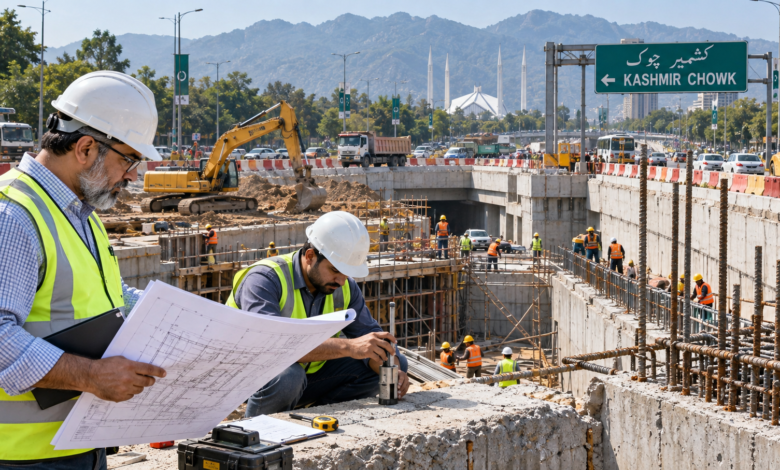
ISLAMABAD: A public call to prioritise construction quality and long-term durability over record-breaking completion times has emerged as work begins on Islamabad’s Kashmir Chowk Underpass, one of the Capital Development Authority’s latest fast-track infrastructure projects.
Journalist Urges Focus on Quality
Islamabad-based journalist Saqib Bashir urged the authorities not to make the Kashmir Chowk project part of a race to establish another construction-speed record, arguing that a major public infrastructure project should instead be completed within an appropriate timeframe with a strong focus on durability and workmanship.
In a post on X, Bashir referred to the earlier F-8 Exchange Chowk and Serena Chowk projects and said their rapid completion had been widely highlighted as achievements. He claimed that shortcomings remained visible at the two locations and appealed to the authorities to ensure that Kashmir Chowk was constructed strongly rather than being rushed merely to establish another record.
While Bashir referred to the scheme as the Kashmir Chowk “flyover,” the project currently being executed by the CDA is officially described as the Kashmir Chowk Underpass Project.
One-Month Completion Target
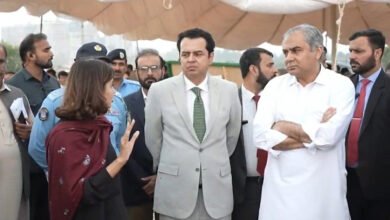
Prime Minister Shehbaz Sharif formally laid the foundation stone of the project on October 6. CDA says it will cost approximately Rs1.4 billion, reduced from an initial estimated cost of around Rs1.6 billion through cost optimisation.
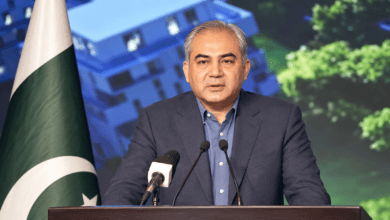
The authority has announced an ambitious one-month completion target. Prime Minister Shehbaz Sharif also publicly appreciated Interior Minister Mohsin Naqvi for setting the one-month timeline during the groundbreaking ceremony.
That target is considerably shorter than the timeline contained in earlier bidding documents. According to reporting based on the tender documents, the formal construction period was 90 days, although CDA officials had already indicated before the groundbreaking that they hoped to finish the scheme ahead of schedule.
Project Aims to Ease Traffic Congestion
Kashmir Chowk is among Islamabad’s busiest junctions. CDA estimates that approximately 107,000 vehicles pass through the intersection every day, with congestion becoming particularly severe during peak hours and VIP movements.
The project includes underpass arrangements intended to improve traffic movement from the Serena side and from Faizabad towards Murree, along with four new slip roads designed to distribute traffic more efficiently. Around five acres of additional land are also expected to be incorporated into the expanded road infrastructure.
Officials say the project will eventually be integrated with planned improvements to Islamabad Expressway and could help reduce travel time between Islamabad and Rawalpindi to around 16 to 18 minutes once the broader road-network improvements are completed.
Past Projects Raise Durability Questions
Bashir’s criticism comes against the backdrop of previous high-profile projects where completion speed was prominently highlighted by government officials. The F-8 Exchange Chowk underpass, for example, was officially described as having been completed in a record 42 days, while authorities had initially pushed for Serena Chowk Interchange to be completed within 60 days.
Questions over resilience later surfaced following Islamabad’s monsoon rains. Dawn reported in 2025 that rainwater had choked the Serena underpass and that a road section at the F-8 interchange had also sustained damage. Separately, reports said a road section around the Serena/Jinnah Square project had caved in following heavy rainfall.
Those incidents, however, do not by themselves establish that rapid construction caused the damage, and no technical finding cited here proves such a connection. Bashir’s remarks represent his own assessment and call for greater emphasis on construction standards.
The Kashmir Chowk project therefore presents an important test for the CDA: delivering urgently needed traffic relief while ensuring that the one-month target does not overshadow structural quality, drainage, road-base preparation, safety checks and long-term durability.
With more than 100,000 vehicles using the junction daily, the performance of the new infrastructure will ultimately be measured not only by how quickly it is completed, but how reliably it serves Islamabad in the years ahead.