Pakistan Appoints First Climate Change Authority Chairman
Establishment Division notification appoints Hamza Farrukh as the first chairman of the Pakistan Climate Change Authority for a two-year term.

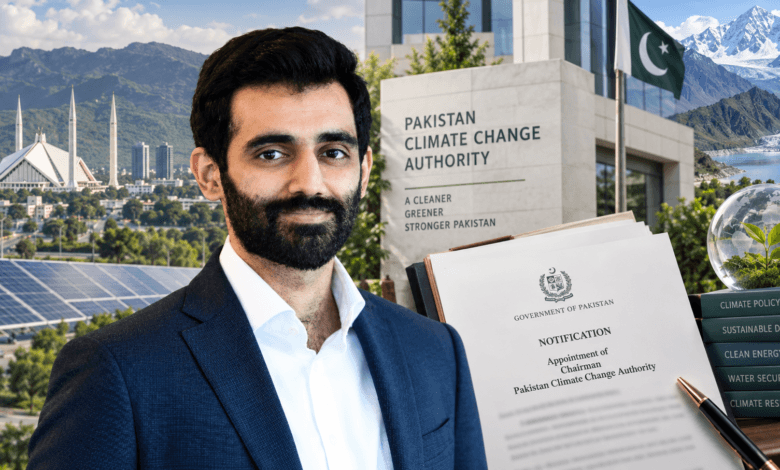
ISLAMABAD: Hamza Farrukh has been appointed as the first chairman of the Pakistan Climate Change Authority (PCCA), marking a key step towards operationalising the country’s federal climate governance body.
According to the appointment information shared with Islamabad Tribune, the process was completed following approval from the prime minister, with the Establishment Division issuing the formal notification. Farrukh has been appointed for a two-year term.
The appointment places Farrukh at the helm of an authority established to strengthen Pakistan’s institutional response to climate change and coordinate measures related to climate policy, adaptation and mitigation.
Farrukh Brings Finance and Climate-Tech Experience
Farrukh brings experience spanning finance, climate technology and social entrepreneurship. Independent institutional sources confirm that he studied at Williams College and spent an academic year at Exeter College, University of Oxford. He later pursued an MBA at Stanford Graduate School of Business.
Before moving deeper into climate-focused work, Farrukh spent around eight years at Goldman Sachs. His professional background included serving as a vice president, while his work subsequently focused on climate technology and clean-water initiatives.
Farrukh founded Bondh E Shams, also known as the Solar Water Project, an initiative focused on solar-powered clean-water solutions for underserved communities. Stanford’s Emergence programme says his work has delivered clean water to more than 150,000 people across multiple countries. He has also been associated with Hydrosun Technologies, a climate-tech venture developing renewable-powered water solutions.
Appointment Comes Amid Climate Governance Efforts
His appointment comes as Pakistan continues to strengthen the institutional framework for dealing with climate risks, including extreme weather, water stress, glacial hazards and climate adaptation.