Islamabad Traders Blast Economic Policies, Warn of Shutdown
Islamabad traders say shops will close from 3pm to 5pm on Thursday, October 8, as they press authorities over plastic-bag enforcement, taxation, electricity costs and what they describe as excessive administrative pressure.

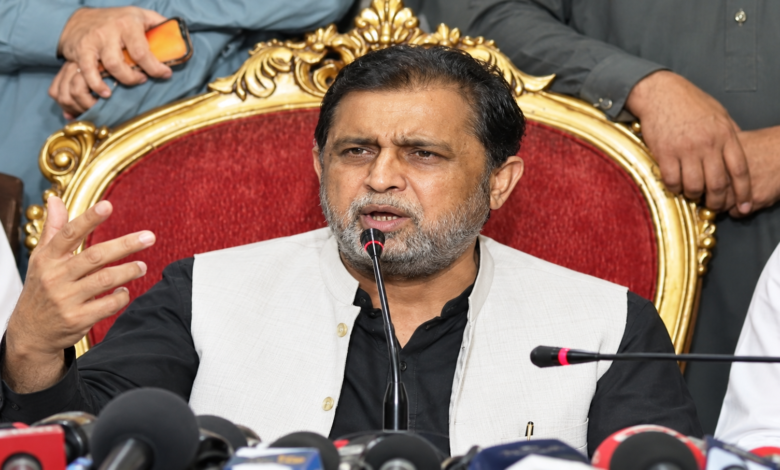
ISLAMABAD: Traders in the federal capital have announced a two-hour closure of shops on Thursday, October 8, while warning that their campaign could expand into a citywide shutter-down if their concerns over government economic and enforcement policies are not addressed.
Traders to Shut Shops From 3pm to 5pm
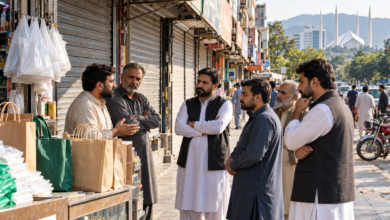
All Pakistan Anjuman-e-Tajiran President Ajmal Baloch, addressing a press conference at the National Press Club Islamabad, said businesses across the capital would remain closed from 3pm to 5pm, with traders expected to gather at Aabpara Chowk and in their respective markets. Reports said trader representatives would decide their next course of action after Thursday’s demonstration.
Baloch criticised what he described as an increasing reliance on punitive administrative measures instead of consultation with the business community. He argued that whenever a restriction is introduced, authorities should first ensure that affordable and workable alternatives are available for traders and consumers.
Plastic Bag Crackdown Becomes Major Dispute
A major point of dispute is the recent enforcement drive against prohibited plastic shopping bags across Islamabad.
The Islamabad district administration has intensified implementation of restrictions on polythene bags under the Single-Use Plastics (Prohibition) Regulations 2023. During one recent citywide operation, authorities reported 122 detentions, seizure of 293 kilograms of plastic bags and sealing of seven shops. Another enforcement operation reported by Dawn involved 88 shopkeepers and nine sealed outlets.
Deputy Commissioner Islamabad Irfan Memon has said the campaign is intended to reduce environmental pollution, protect Islamabad’s natural environment and discourage plastic waste that can block drains and create sanitation problems. Authorities have urged businesses to switch to environment-friendly alternatives.
The restrictions themselves are not new. Pakistan Environmental Protection Agency records show that a ban on unauthorised manufacture, distribution, sale, purchase, storage and use of polythene bags in Islamabad was notified in 2019. Pak-EPA says specified industrial, municipal, hospital and hazardous-waste uses may be permitted subject to authorisation.
Enforcement under the wider single-use plastic framework has also continued throughout 2026. Pak-EPA reported inspections and confiscations in areas including Ghauri Town, F-11, Tarlai Kalan, Khanna Pul, Tarnol and Saddar earlier this year.
Traders Raise Broader Economic Concerns
However, Baloch maintained that traders support efforts to keep Islamabad clean and reduce pollution but oppose what they consider disproportionate enforcement. He called on authorities to stop the supply of prohibited bags at the manufacturing and wholesale level and ensure affordable alternatives are readily available before taking stringent action against individual retailers.
The traders’ leadership also raised broader economic concerns, including electricity prices, taxation and interaction with government departments. Baloch claimed that business owners were facing unprecedented pressure and said he had not witnessed comparable conditions during his 28 years representing traders.
He further cited poverty as evidence of wider economic difficulties, claiming that around 120 million Pakistanis were below the poverty line. That figure should be understood as a claim made during the press conference rather than a single uncontested official poverty measure.
World Bank poverty figures vary significantly depending on the benchmark used. The Bank’s revised international lower-middle-income poverty threshold is $4.20 per person per day, while its separate extreme-poverty threshold is $3 per day. World Bank assessments have stressed that international thresholds and Pakistan’s national poverty line serve different purposes and should not be treated as interchangeable.
The immediate focus now shifts to Thursday’s planned two-hour market closure. Trader representatives have indicated that their response could be expanded if discussions with the authorities fail to produce what they consider a practical resolution.