From NOCs to Removals: Islamabad Traders Question Sudden Policy Shift
Businesses say they paid fees and invested in outdoor spaces after obtaining official permissions, but recent removal operations have raised questions about regulatory consistency, transparency and the treatment of existing approvals.

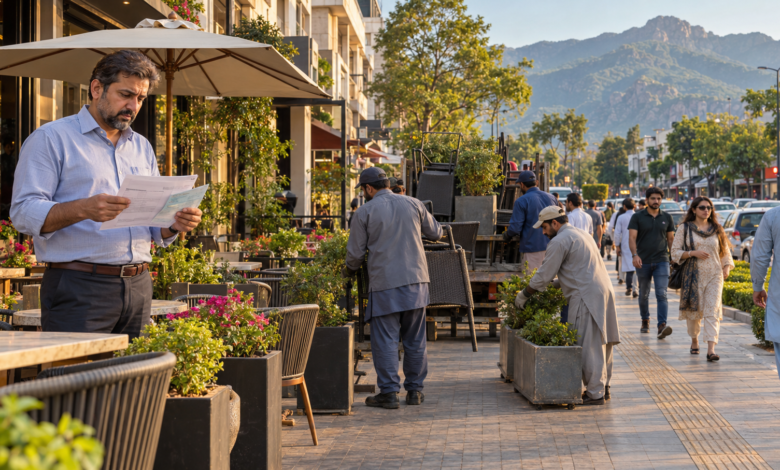
ISLAMABAD: October 18, 2026: A city’s character is shaped not only by its roads and buildings, but also by the places where people gather. In Islamabad, outdoor seating at hotels, restaurants and cafés has become part of everyday urban life. It provides residents with places to meet, supports local businesses and adds character to commercial areas when managed responsibly.
That is why the recent action against outdoor arrangements across the federal capital has raised concerns among business owners and residents alike.
For months, the government’s stated approach appeared to encourage commercial activity through regulated permissions. Businesses could apply for temporary use of designated outdoor spaces, subject to municipal conditions and payment of prescribed charges.
Traders say they followed the relevant procedures, paid fees, obtained no-objection certificates (NOCs) or other permissions and invested substantial amounts in improving their outdoor facilities.
Now, according to accounts shared by affected businesses, enforcement operations have brought uncertainty to those investments.
Business owners report that teams from the Directorate of Municipal Administration (DMA) have been removing chairs, tables and other outdoor arrangements from commercial areas. They also claim that decorative flower pots have been taken away from Kohsar Market and other locations.
The Need for Predictable and Transparent Regulation
The central question is not whether public spaces should be regulated. They should.
Islamabad’s roads, footpaths and pedestrian corridors must remain accessible. Commercial establishments are expected to comply with municipal regulations, traffic requirements and public safety standards. Authorities have a legitimate responsibility to address obstructions and unauthorised use of public land.
However, regulation must also be predictable, transparent and consistent.
The official municipal framework itself recognises temporary permissions for outdoor seating. The DMA’s published licensing information identifies outdoor seating among activities for which temporary open-space licences may be obtained.
In July 2026, municipal authorities reportedly directed restaurants to clear public footpaths of outdoor seating, decorative items and other obstructions. The stated objective was to protect pedestrian access and ensure that seating remained within designated, approved areas.
Subsequently, in September, the Metropolitan Corporation Islamabad (MCI) announced temporary seating arrangements for restaurants around the public sit-out area at F-10 Markaz while consultations continued over the proposed Open Space Policy for 2026–27.
Those arrangements were subject to conditions protecting pedestrian movement, access and emergency routes, with licensing required for continued use beyond the temporary period.
These developments indicate that the underlying issue is more complicated than a straightforward prohibition on outdoor dining.
The real dispute concerns the distinction between permitted commercial use, temporary approvals and unauthorised occupation of public spaces.
Questions Over Permits, Fees and Enforcement
If businesses obtained approvals and paid the required charges, they are entitled to ask what those documents authorised, how long they remained valid and whether their particular arrangements complied with the approved site plans.
If the government has introduced revised conditions, affected traders deserve clear notice, a published explanation and a reasonable opportunity to make necessary adjustments.
Abrupt enforcement, particularly where businesses say they invested in reliance on official permissions, risks undermining confidence in the regulatory system.
The timing has also prompted legitimate questions.
Traders may perceive the situation as unfair if they were encouraged to invest, required to pay municipal charges and subsequently directed to dismantle those arrangements without sufficient explanation.
That perception deserves a direct response from the relevant authorities rather than speculation about their intentions.
The government should clarify whether any permits have expired, been suspended or revoked; whether the affected installations exceeded the approved limits; and what notices, if any, were issued before removal.
Flower Pots and the Question of Public Access
The reported confiscation of flower pots has become a particularly visible symbol of the controversy.
Decorative planters may improve the appearance of commercial areas, but they can also obstruct pedestrian routes depending on their placement. Their removal should therefore be assessed against clearly communicated rules and the actual conditions at each location.
If a planter, chair or temporary structure violates an approved layout or obstructs a public route, the responsible authority should identify the violation and follow a consistent enforcement procedure.
At the same time, the concerns of businesses that complied with the licensing system should not be dismissed.
A city cannot reasonably expect entrepreneurs to invest with confidence if the practical meaning of official permissions remains uncertain.
Calling for accountability does not mean opposing municipal regulation. It means advocating regulation that protects public access while treating legitimate commercial activity fairly.
A well-managed capital should be capable of achieving both objectives.
What Municipal Authorities Should Clarify
Municipal authorities should publish the applicable outdoor-seating rules, clarify the status of previously issued NOCs and temporary licences, explain the treatment of fees already paid and establish an accessible mechanism for reviewing disputed enforcement actions.
These steps would help businesses distinguish between what is prohibited, what may be licensed and what adjustments are necessary for compliance.
Islamabad needs orderly streets, accessible public spaces and attractive commercial centres. But it also needs trust between residents, entrepreneurs and public institutions.
That trust depends on policies being communicated clearly and implemented consistently.
When businesses believe that official approvals no longer provide the certainty they expected, the resulting frustration can extend well beyond outdoor seating.
The authorities have an opportunity to address the present concerns through transparent communication, consistent application of municipal rules and fair consideration of existing permissions.
Until then, traders and residents will continue to ask a straightforward question:
If businesses were permitted to pay fees, obtain approvals and invest in outdoor facilities, what precisely changed—and why are those arrangements now being removed?
Editor’s Note: This article is an opinion column reflecting the writer’s analysis and concerns attributed to affected businesses. Claims concerning individual permits, payments and recent removals have not been independently established. The Metropolitan Corporation Islamabad, Directorate of Municipal Administration and other relevant authorities are encouraged to provide their official position. Their responses may be incorporated into subsequent reporting.