Islamabad Model Jail Faces Senate Heat
Committee raises concerns over missing women's facilities and repeated delays; CDA promises Phase-I completion within one month

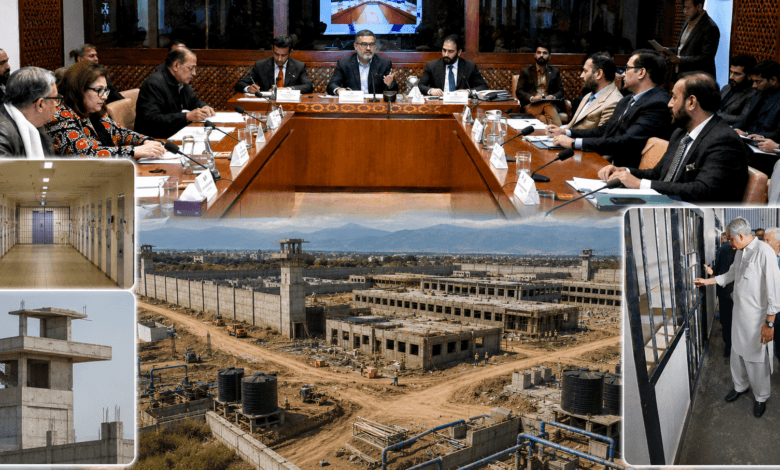
ISLAMABAD: The Senate Standing Committee on Housing and Works has expressed serious concerns over the design and prolonged delay of the Islamabad Model Jail project, questioning how a facility envisioned as a “model prison” could initially be designed without dedicated accommodation for women prisoners and adequate drinking-water arrangements.
During the committee meeting, the chairman criticized the original design, observing that women constitute nearly half of the country’s population yet were effectively excluded from the first phase of the prison project.
“What kind of model jail has been designed in which half of the population—women—has no place?” the committee chairman asked while reviewing the project’s progress.
The committee was informed that the project, which has remained under development for nearly a decade, is still incomplete despite multiple completion deadlines. The chairman expressed skepticism over the latest assurances, saying the committee was not convinced the remaining work could realistically be completed within the timelines being presented.
Responding to the criticism, CDA Chairman Lt. (Retd.) Sohail Ashraf stated that the shortcomings belonged to the original approved design prepared before the CDA assumed responsibility for the project. He said the authority had significantly accelerated construction after taking over.
According to the CDA chairman, women’s barracks and other missing facilities will be incorporated during Phase-II, while Phase-I will be completed within one month. The Senate committee has announced an on-site inspection of the project on August 2 to independently assess the progress.
Background of the Project
The Islamabad Model Jail, also known as the Islamabad Prison Complex, is being constructed over 90 acres in Sector H-16. Islamabad has historically lacked its own prison, forcing authorities to transfer prisoners arrested in the federal capital to the overcrowded Adiala Jail in Rawalpindi.
Once fully operational, the prison is designed to accommodate around 2,000 inmates and is intended to function as a modern correctional and rehabilitation facility rather than merely a detention center, in line with Pakistan’s prison reform objectives.
Why Has the Project Been Delayed?
Although the project received approval in 2011 and construction formally began several years later, it has missed more than six completion deadlines due to multiple challenges.
One of the primary reasons has been chronic funding shortages, as delayed and insufficient allocations under the Public Sector Development Programme (PSDP) repeatedly slowed construction.
The project also faced planning deficiencies. During its review, the Senate Standing Committee pointed out that the original design failed to include:
- Dedicated barracks for women prisoners.
- Facilities for mothers with infants.
- Educational arrangements for juvenile inmates.
Addressing these shortcomings required redesigning portions of the project, contributing to further delays.
In addition, construction costs escalated significantly over the years. The project, initially estimated at around Rs3.7 billion, has undergone several cost revisions because of inflation, revised designs, and prolonged construction, requiring repeated financial and administrative approvals.
Modern Rehabilitation Facility
The Islamabad Model Jail has been planned under the National Prison Reform Action Plan and includes several modern rehabilitation and welfare features.
The complex will include:
- A 22-bed hospital.
- A mosque.
- Central library.
- Auditorium.
- Educational facilities, including a school for the children of jail staff.
Separate accommodation is planned for women prisoners and juvenile offenders, reflecting international human rights standards and prison reform principles.
For security, the prison will feature:
- Dual-layer perimeter walls.
- Digital surveillance systems.
- A centralized control room designed to improve operational monitoring and inmate management.
Current Progress
According to government officials, construction has accelerated considerably during recent months.
Authorities say more than 85 percent of the overall project has been completed. The main administrative buildings and Barracks 1 and 2 have been completed, while Barracks 3 is reportedly nearing completion. Internal roads, street lighting, water filtration infrastructure, and other utility works are also in their final stages.
To overcome financial constraints, the Economic Coordination Committee (ECC) approved additional funding to clear outstanding liabilities, while the federal government allocated Rs1 billion for the project under the 2026–27 Public Sector Development Programme (PSDP).
Interior Minister Mohsin Naqvi and the CDA management have directed contractors to work in double shifts to expedite the remaining construction. Meanwhile, the Islamabad High Court has periodically reviewed the project’s progress as part of efforts to ensure timely completion.
Officials have also initiated the recruitment and training of prison staff so that inmates can be transferred from Adiala Jail immediately after the facility becomes operational.
Why the Project Matters
The absence of a dedicated prison in Islamabad has long created administrative, security and logistical challenges. Prisoners arrested in the capital must routinely be transported between Islamabad courts and Adiala Jail in Rawalpindi, increasing security risks and operational costs.
A fully functional Islamabad Model Jail is expected to:
- Ease pressure on Adiala Jail.
- Improve prisoner transportation.
- Strengthen security arrangements.
- Provide modern rehabilitation, healthcare and correctional facilities within the federal capital.
Despite the latest assurances, the Senate committee has made it clear that it will judge progress through its planned inspection on August 2, when members will assess whether the promised completion schedule reflects the actual condition of the project on the ground.