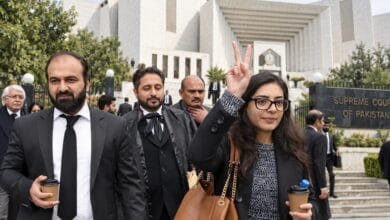
Supreme Court Says Khula Requires Wife’s Free Consent
Five-member bench led by Justice Shahid Waheed says courts cannot convert a woman’s dissolution petition into khula without her clear and voluntary choice, while recognising serious and persistent marital discord as a separate basis for dissolution without automatic loss of dower rights.

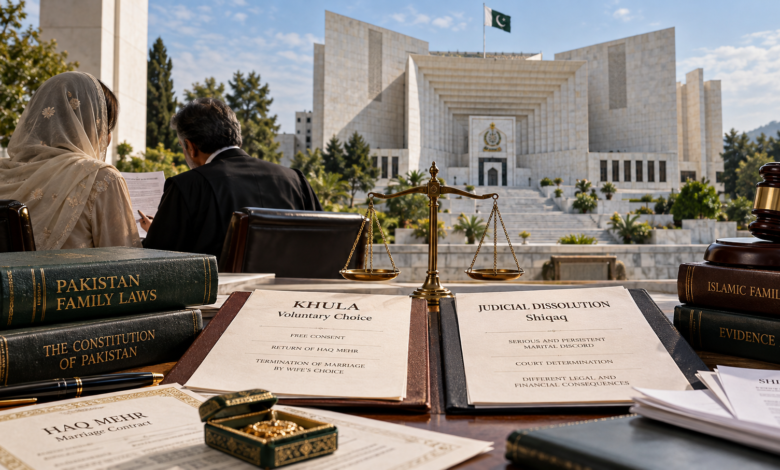
ISLAMABAD: The Supreme Court of Pakistan has laid down important principles governing khula, dissolution of Muslim marriages and a woman’s financial rights, holding that a court cannot impose khula on a wife without her clear, informed and voluntary consent.
According to the written order, a petition filed by a woman seeking dissolution of marriage on another legal ground cannot simply be converted by a court into a decree of khula merely because the originally pleaded ground is not established.
The ruling is significant because khula and judicial dissolution under the Dissolution of Muslim Marriages Act, 1939, may carry different financial consequences, particularly in relation to dower, or Haq Mehr.
The Supreme Court held that a woman should not be deprived of her dower merely because a court, on its own, decides to treat her dissolution case as one of khula. The written order consequently set aside directions requiring the women in the cases before it to return or relinquish dower on the basis of khula.
Court Maintains Dissolution on Basis of Shiqaq
The court instead maintained the dissolution of two marriages on the basis of shiqaq — serious and persistent marital discord — rather than khula.
The judgment explained that shiqaq may provide a lawful basis for dissolution where differences between spouses have become genuine, serious and continuing, and meaningful attempts at reconciliation have failed.
However, the court stressed that every disagreement between spouses cannot amount to shiqaq. Ordinary arguments, differences of temperament or a temporary period of separation would not by themselves be sufficient.
A court must examine the evidence and circumstances and satisfy itself that the marital discord is substantial and persistent and that reconciliation has failed despite a meaningful judicial effort.
Dower Rights Protected
This reasoning is linked to Section 2(ix) of the Dissolution of Muslim Marriages Act, 1939, which allows a Muslim woman to seek dissolution on “any other ground” recognised as valid under Muslim law. Pakistan’s official statutory text confirms that Section 2 separately identifies cruelty and then preserves other Muslim-law grounds through this residual clause.
The Supreme Court further ruled that dissolution on the basis of shiqaq does not depend on a woman surrendering her dower. The distinction is important because khula can carry financial consequences that are different from a dissolution granted on an independently established legal ground.
The judgment also cautioned courts against declaring a husband responsible for mistreatment where the allegation has not been proved on the evidence. Family litigation, the court observed, must protect the lawful rights, dignity and reputation of both parties.
Supreme Court Builds on Earlier Rulings
The latest ruling follows a developing line of Supreme Court jurisprudence limiting courts’ ability to unilaterally convert dissolution proceedings into khula. In May 2026, the apex court held that where a woman had sued on another matrimonial ground and valuable financial rights were involved, khula should not ordinarily be granted without her clear election.
Earlier, in January 2026, the Supreme Court similarly ruled that a lower court could not convert proceedings under the Dissolution of Muslim Marriages Act into khula in the absence of a clear and unequivocal statement by the wife, particularly where doing so would affect her dower entitlement.
The Supreme Court has also recently reinforced the legal status of dower itself. In a separate September 2026 judgment, it described Haq Mehr as a mandatory legal incident of marriage and the exclusive proprietary right of the wife rather than a “price” paid for marriage.
Taken together, the rulings establish an increasingly clear distinction between khula voluntarily elected by a woman and dissolution granted by a court on a recognised legal or Muslim-law ground. That distinction can determine whether a woman is required to relinquish any part of her financial entitlement.
The written judgment was delivered by a five-member Supreme Court bench headed by Justice Shahid Waheed. The court maintained the orders relating to maintenance and dowry articles in the cases before it while modifying the legal basis on which the marriages were dissolved.