Islamabad District Courts Receive 56,708 Cases in Six Months
Islamabad’s district judiciary disposed of more cases than were newly instituted during the first half of 2026, but 46,979 cases remained pending at the end of June, while two of the capital’s 13 listed special courts and tribunals currently have vacant judicial seats.

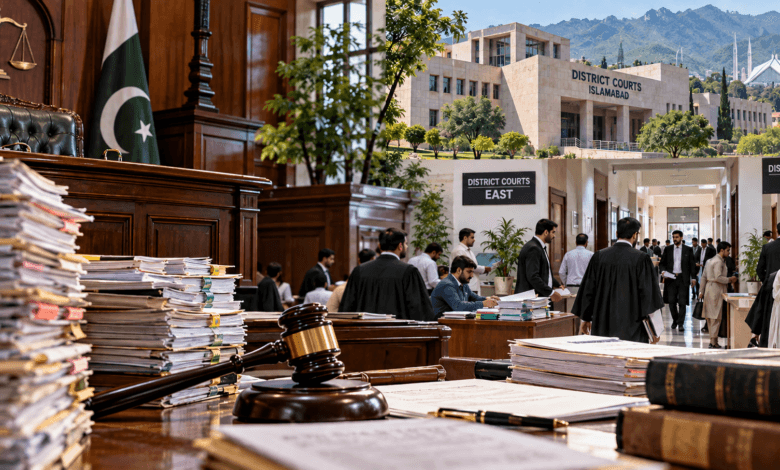
ISLAMABAD: Islamabad’s district courts disposed of 61,113 cases during the first six months of 2026, exceeding the 56,708 fresh cases instituted during the same period, but nearly 47,000 cases were still awaiting adjudication at the end of June, according to judicial statistics and official court information reviewed by Islamabad Tribune.
The figures show that the federal capital’s district judiciary started 2026 with 51,225 pending cases. Between January 1 and June 30, 56,708 new cases were instituted, while 61,113 cases were disposed of. After adjustments involving physical verification, restoration, reopening, remand or related changes, the balance stood at 46,979 pending cases as of June 30, 2026.
The statistics supplied with the report are consistent with separately published figures showing 56,708 institutions, 61,113 disposals and 46,979 pending cases in Islamabad’s district courts during the period.
This means the district judiciary disposed of 4,405 more cases than were newly filed during the six-month period. Compared with the opening pendency of 51,225, the end-June backlog was lower by 4,246 cases after the statistical adjustments reflected in the official statement.
Civil Cases Form Majority of Backlog
A breakdown of the pending caseload shows that 29,092 civil cases remained undecided in Islamabad’s district courts, compared with 17,887 criminal cases. Civil matters therefore exceeded criminal cases by 11,205 cases and represented roughly 62 percent of the district judiciary’s pending caseload.
The figures highlight the scale of the workload facing the capital’s subordinate judiciary even as disposals during the first half of the year outpaced fresh institutions.
East and West Sessions Divisions
Islamabad’s district judiciary operates through separate East and West Sessions Divisions, a territorial arrangement that dates back to the division of the capital’s judicial districts in 2012. The divisions allocate different geographical areas of Islamabad to their respective courts.
The Islamabad District Courts’ current official portal identifies Muhammad Yar Gondal as District & Sessions Judge (East) and Nasir Javed Rana as District & Sessions Judge (West).
The East-West structure effectively divides territorial jurisdiction and court administration across the federal capital. The official system also maintains separate e-filing arrangements for the East and West district courts.
117 Judicial Posts Sanctioned
According to information obtained regarding the district judiciary, a total of 117 judicial posts are sanctioned across the Islamabad judicial setup covered by the data.
These comprise 15 District & Sessions Judge posts, 30 Additional District & Sessions Judge posts, 20 Senior Civil Judge posts and 50 Civil Judge-cum-Judicial Magistrate posts, along with two posts designated for women civil judges/presiding officers.
The sanctioned strength illustrates the institutional framework required to handle tens of thousands of civil and criminal proceedings moving through the capital’s district courts each year.
13 Special Courts and Tribunals Listed
Beyond the regular district judiciary, Islamabad also has 13 listed special courts and tribunals dealing with specialised categories of litigation.
The Islamabad High Court’s official directory currently lists two Special Courts for Control of Narcotic Substances cases, two Banking Courts, two Anti-Terrorism Courts, two Accountability Courts and two Special Courts (Central). It also lists a Special Court for Offences in Banks, an Intellectual Property Tribunal and an Environmental Protection Tribunal.
Of the 13 listed institutions, the official directory currently identifies judicial officers for 11, while two positions are shown as vacant. The vacant positions are at Accountability Court-II and the Environmental Protection Tribunal.
The remaining listed courts are headed by designated judicial officers, with the Anti-Terrorism Court-I judge also shown as having additional responsibility as the designated court under the Official Secrets Act, 1923.
The broader national judiciary has meanwhile been pursuing measures aimed at improving case management and institutional performance. The Law and Justice Commission of Pakistan launched the National Judicial Analytics Dashboard in February 2026, intended to support data-driven judicial policymaking and greater transparency.
The National Judicial (Policy Making) Committee has also recently highlighted disposal performance across Pakistan’s district judiciary as part of its efforts to accelerate justice delivery and strengthen institutional capacity.
Additional reporting based on details attributed to Samaa News correspondent Muhammad Aalijah Khan; key statistics and current court appointments were cross-checked against publicly available judicial sources.