NCCIA Rawalpindi Holds Awareness Walk Against Growing Cybercrime Threats
Under DG Syed Ali Nasir Rizvi’s directions, NCCIA officers, students, civil society and residents join an awareness walk promoting safer passwords, protection of personal information and responsible digital practices.

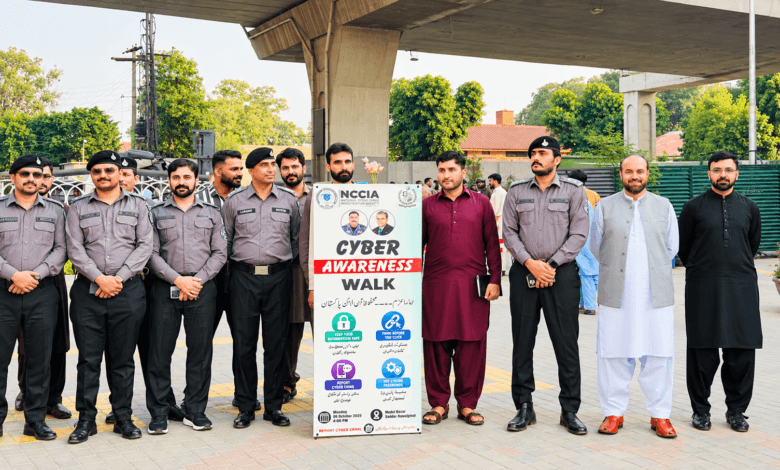
RAWALPINDI, October 6, 2026: The National Cyber Crime Investigation Agency’s Rawalpindi Circle has taken its public-awareness campaign beyond offices and investigation rooms, organising a cyber-safety walk aimed at helping citizens recognise emerging digital risks and adopt safer online habits.
Officials, Students Join Cyber-Safety Walk
The activity was organised on the special directions of NCCIA Director General Syed Ali Nasir Rizvi and brought together the Additional Director Rawalpindi Circle, deputy directors, agency officers and personnel, students, representatives of civil society and members of the public, according to an official NCCIA press release.
Participants carried banners and placards carrying messages on responsible internet use, stronger passwords, protection of personal information and precautions citizens can take while interacting with unfamiliar people, links, applications and digital platforms.
Officials briefed participants on a range of online risks, including deceptive financial schemes, misuse of personal information, unwanted online contact, AI-generated deepfakes and harmful material involving children. They particularly advised citizens against opening suspicious links, sharing private photographs or sensitive information with unknown individuals, and installing unverified loan applications.
NCCIA Focuses on Prevention and Awareness
The Rawalpindi initiative comes as the NCCIA leadership places increasing emphasis on prevention and public education alongside investigation and enforcement. Rizvi recently directed the agency to strengthen public-awareness efforts so citizens receive timely information about emerging digital risks and ways to protect themselves.
The agency’s official guidance similarly urges internet users to verify recipients before transferring money, avoid suspicious messages and links, keep passwords, PINs and one-time passwords private, and regularly monitor financial accounts for unusual activity.
Rizvi said the cyber-awareness campaign would continue across Pakistan, with particular emphasis on improving digital literacy among young people and women and protecting citizens’ digital rights.
The campaign also reflects the broader mandate the NCCIA says it has adopted: combining investigation and prosecution with prevention, public awareness, technological capability and citizen cooperation to build a safer digital environment.
Rawalpindi Circle Covers Six Districts
The Rawalpindi Circle has a wider regional role beyond the city itself. According to the NCCIA’s official jurisdictional information, the circle covers Rawalpindi, Murree, Talagang, Attock, Chakwal and Jhelum, making awareness initiatives launched from Rawalpindi potentially relevant to a substantial population across northern Punjab.
Officials urged citizens facing a digital-related complaint to report the matter promptly rather than remaining silent, enabling the agency to assess the complaint and initiate action under the applicable legal framework.
Helpline Number Clarification
Contact-number clarification: The press release provided for this story cites 1719 as an NCCIA helpline. However, the agency’s current official website lists 1799 as its helpline and also directs citizens to complaint.nccia.gov.pk for online complaints. Islamabad Tribune has therefore treated 1799 as the currently verified official website number while noting the discrepancy in the issued release.
The NCCIA website also lists its Rawalpindi office at Punj Sarrki near Adam Jee Road in Saddar and provides a dedicated Rawalpindi contact number for citizens seeking assistance from the circle.