Pakistan Launches Examination Reforms Across 27 Education Boards
Steering Committee chaired by Executive Director Dr. Ghulam Ali Mallah reviews the proposed National Examination Quality Standardized Index to improve assessment quality, transparency and international recognition of Pakistani qualifications.

ISLAMABAD, October 14, 2026: The federal government has stepped up efforts to reform Pakistan’s examination system, with the Inter Boards Coordination Commission (IBCC) advancing a proposed nationwide quality assurance framework aimed at introducing internationally benchmarked assessment standards across 27 public-sector examination boards.
The initiative, known as the National Examination Quality Standardized Index (NEQSI), seeks to establish a consistent mechanism for evaluating examination quality, improving transparency and fairness, and strengthening the credibility of secondary and higher secondary qualifications throughout Pakistan.
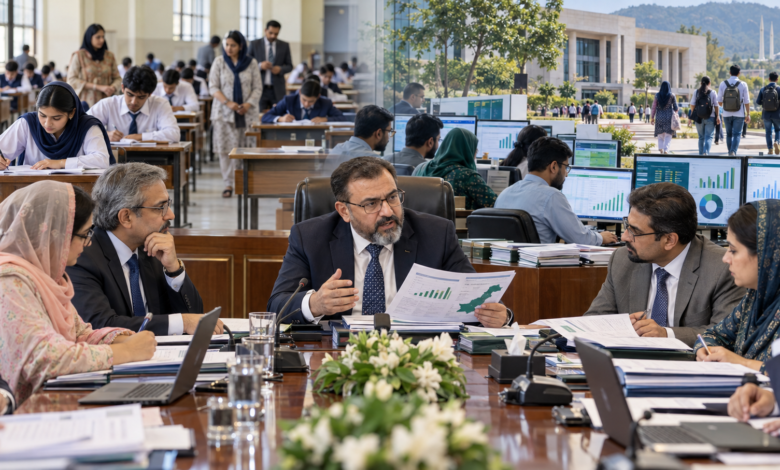
The first meeting of the NEQSI Steering Committee was held at the IBCC Secretariat in Islamabad under the chairmanship of Dr. Ghulam Ali Mallah, Executive Director of IBCC, following directives issued by the Secretary of the Ministry of Federal Education and Professional Training.
According to an official press release, the meeting marked an important step in developing a coordinated national framework designed to improve examination and assessment practices across the country’s public-sector education boards.
Steering Committee Reviews National Reform Framework
During the meeting, committee members conducted a detailed review of the proposed NEQSI framework, focusing on the indicators, performance targets and implementation milestones intended to guide the initiative.
The proposed index aims to introduce common quality benchmarks that will enable examination boards to assess their performance against consistent standards while supporting improvements based on measurable evidence.
To further strengthen the framework, the Steering Committee constituted a Sub-Committee tasked with refining the proposed indicators and performance targets.
The Sub-Committee will present its recommendations at the next Steering Committee meeting, allowing further consultation before the framework is finalized.
The IBCC has not yet announced a final set of assessment indicators or a confirmed nationwide implementation schedule in its October 14 press release.
Common Standards for 27 Public-Sector Boards
A central objective of NEQSI is to promote greater consistency in examination quality among Pakistan’s 27 public-sector examination boards.
These boards conduct examinations and award qualifications that play an important role in determining students’ progression to colleges, universities and other higher education institutions.
The proposed framework is intended to establish internationally referenced standards for evaluating examination systems, enabling the IBCC and participating boards to identify areas requiring improvement.
Rather than immediately replacing existing examination structures, the initiative focuses on creating a common quality assurance mechanism that can support coordinated improvements across different boards.
According to IBCC, the framework will encourage evidence-based decision-making, strengthen assessment practices and contribute to a more reliable national examination system.
International Recognition of Pakistani Qualifications
One of the expected benefits of the proposed reforms is stronger international recognition of Pakistani secondary and higher secondary educational qualifications.
The IBCC believes that a consistent and transparent quality assurance system can help improve confidence in examination results and support students seeking admission to educational institutions both within Pakistan and abroad.
Differences in assessment procedures and examination standards can complicate comparisons between qualifications issued by different boards.
By introducing common quality indicators and internationally benchmarked assessment standards, NEQSI aims to improve comparability and strengthen confidence in the qualifications issued by Pakistani examination boards.
However, the framework remains under development, and its introduction would not automatically guarantee recognition or admission by foreign universities, which maintain their own eligibility and assessment requirements.
Dr. Ghulam Ali Mallah Highlights Importance of Reforms
Addressing the Steering Committee, Dr. Ghulam Ali Mallah described NEQSI as an important step towards modernizing Pakistan’s examination and assessment system.
He emphasized the need for standardized quality benchmarks, transparency and continuous institutional improvement to strengthen the reliability and international standing of Pakistani educational qualifications.
“NEQSI will help improve the quality of examinations and assessment across the country, align our examination systems with international benchmarks, and strengthen the global recognition of Pakistani qualifications,” Dr. Mallah stated.
“Through a consistent and transparent quality assurance framework, we aim to enhance the credibility of our examinations and expand educational opportunities for our students.”
His remarks highlighted the IBCC’s intention to move towards a more systematic approach to examination quality assurance, supported by common benchmarks and continuous evaluation.
Strengthening Coordination Between Examination Boards
The initiative forms part of broader federal efforts to improve coordination and standardization within Pakistan’s education sector.
The IBCC operates under the Ministry of Federal Education and Professional Training and serves as a national coordinating body for secondary and higher secondary examination boards.
Its responsibilities include promoting consistent examination policies, improving assessment standards and facilitating the recognition and equivalence of educational qualifications.
The proposed NEQSI framework is expected to complement these responsibilities by providing a structured mechanism for monitoring examination quality and identifying opportunities for improvement.
Successful implementation will require continued cooperation between the IBCC, provincial education authorities, examination boards and other relevant stakeholders.
Next Steps in National Examination Reform
Following the first Steering Committee meeting, the newly constituted Sub-Committee will refine the proposed quality indicators and targets before submitting its recommendations for further consideration.
The IBCC will continue consultations with relevant stakeholders and examination boards as work progresses on the national framework.
The initiative is designed to move Pakistan towards a more transparent, reliable and internationally comparable examination system while supporting better educational opportunities for students.
For the federal government and IBCC, the immediate priority is to translate the proposed framework into measurable standards and practical institutional reforms capable of improving examination quality across the country’s 27 public-sector boards.