Ishaq Dar Faces Questions Over Emergency’s Legal Basis
Questions over the constitutional grounds for emergency measures and governor’s rule arise as the federal government defends its decision and legal bodies call for scrutiny.

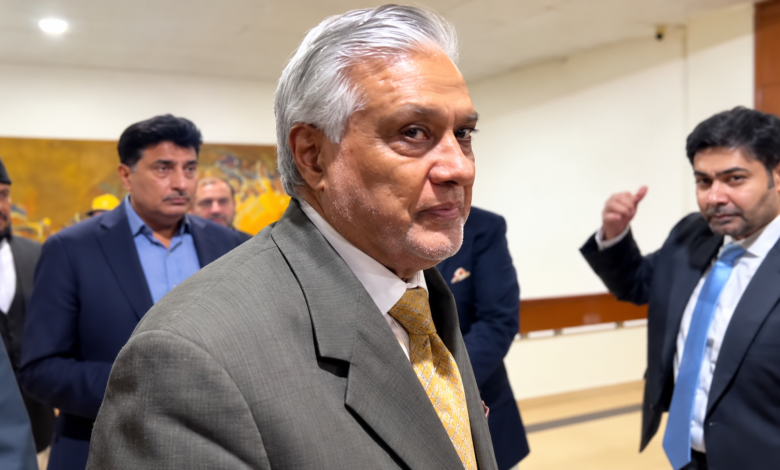
ISLAMABAD, October 13, 2026: Deputy Prime Minister and Foreign Minister Senator Ishaq Dar has come under questions over the imposition of emergency measures and governor’s rule in Khyber Pakhtunkhwa, as the constitutional basis and legal implications of the federal government’s decision remain under debate.
A reporter raised questions concerning the imposition of emergency and its legal aspects. However, the precise wording of the questions and Dar’s immediate responses during that particular interaction have not been independently verified.
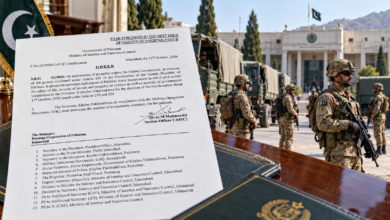
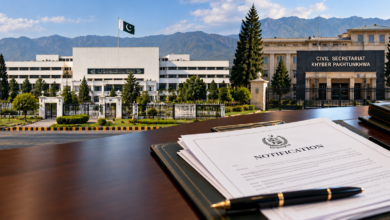
The questions come amid continuing political and legal scrutiny following President Asif Ali Zardari’s October 11 proclamations, issued on the advice of Prime Minister Shehbaz Sharif, invoking Articles 232 and 234 of the Constitution.
The measures placed Khyber Pakhtunkhwa under governor’s rule, while separate emergency arrangements were introduced for 12 designated districts.
Dar Defends Federal Government’s Decision
Addressing a conference in Islamabad on October 12, Ishaq Dar defended the government’s action, maintaining that the decision was driven by concerns over security and was not intended as a political measure.
He argued that the federal government had exhausted other options before resorting to extraordinary constitutional provisions.
Dar maintained that restoring stability and protecting citizens remained central to the government’s approach.
During a Senate session on October 13, he also defended the federal cabinet’s decision to end its reconciliation process with Pakistan Tehreek-e-Insaf, citing disagreements over provincial governance and security cooperation.
Constitutional Provisions Under Examination
Article 232 of Pakistan’s Constitution deals with emergency proclamations in circumstances involving war, external aggression or internal disturbances beyond the capacity of a provincial government to control.
Article 234 provides for extraordinary administrative arrangements when a provincial government cannot be carried on in accordance with the Constitution.
The government maintains that the circumstances in Khyber Pakhtunkhwa justified invoking these provisions.
However, legal representatives have questioned whether the required constitutional conditions and procedural safeguards were satisfied.
A central issue concerns the constitutional requirement relating to a provincial assembly resolution when an emergency is declared on the grounds of internal disturbances.
The duration of governor’s rule and the parliamentary approval process have also become important subjects of debate.
Under Article 234, a proclamation ordinarily requires approval through a joint parliamentary sitting within two months and cannot remain in force beyond the constitutionally prescribed maximum period of six months.
Legal Community Raises Objections
Several bar associations and members of the Pakistan Bar Council have questioned the constitutional basis of the measures.
The Islamabad High Court Bar Association has expressed concerns regarding provincial autonomy and the elected mandate, while legal organisations in Lahore have announced plans to challenge the decision before the Supreme Court.
Meanwhile, the federal government maintains that its actions were taken within the constitutional framework and were necessary in view of the prevailing circumstances.
Parliamentary Scrutiny Continues
The National Assembly and Senate convened on October 13 against the backdrop of the emergency proclamations and the constitutional questions surrounding their implementation.
The situation has brought renewed attention to the relationship between federal authority, provincial autonomy and parliamentary oversight.
The legal debate is expected to remain significant as constitutional processes continue and any challenges proceed through the appropriate judicial forums.
The central question remains whether the circumstances cited by the federal government satisfy the constitutional conditions for extraordinary intervention in an elected provincial administration.