IBCC Unveils Major Reforms for Pakistan’s Examination System
The 184th IBCC Forum in Murree advanced reforms covering a 40% passing threshold, science-group equivalence for foreign-board students, standardized practical examinations, certificate identification and a wider transition from rote learning toward conceptual assessment.

ISLAMABAD: Pakistan’s examination system is moving through a significant reform phase as the Inter Boards Coordination Commission (IBCC) advances changes to grading, assessment, equivalence and academic-record verification, alongside a broader push for digitalization and greater uniformity among examination boards nationwide.
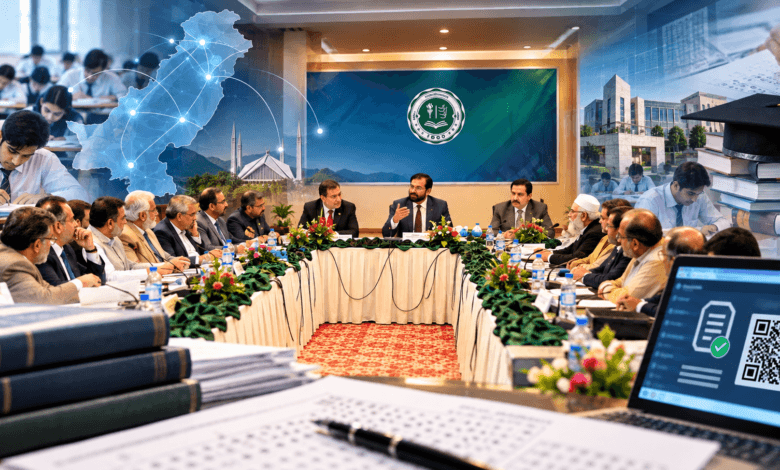
The reform agenda was a central focus of the 184th meeting of the IBCC Forum, held in Murree on September 3-4, 2026. The gathering brought together chairpersons of Boards of Intermediate and Secondary Education from across Pakistan, technical education boards and senior representatives of curriculum and textbook boards.
The forum’s decisions form part of an effort to shift examinations away from excessive dependence on memorisation and toward assessment of students’ understanding and conceptual learning. IBCC says its statutory mandate includes promoting modern examination and assessment techniques and coordinating efforts to bring greater uniformity to secondary and higher-secondary assessment across the country.
40% Passing Threshold Under New Grading Policy
One of the most significant changes affecting students is the new grading policy, under which the minimum passing threshold has been set at 40 percent. The revised framework uses a 10-point grading scheme and is being introduced in phases.
According to IBCC’s official guidance, implementation began with the 1st Annual Examination 2026 and is scheduled to proceed in three phases, with full adoption targeted by 2028. The first phase applies to Grade 9 at SSC level and Grade 11 at HSSC level. IBCC says all public and private examination boards in Pakistan are required to implement the new system, with foreign examination boards operating in Pakistan treated separately.
The phased implementation is intended to allow boards, schools, teachers, students and parents time to adapt to the revised system. IBCC has also been conducting professional-development, training and orientation activities to support implementation.
Shift From Rote Learning to Conceptual Assessment
The reforms go beyond changing the minimum passing percentage. A central objective is to change what examinations measure.
The 184th Forum was presented as part of a wider move from rote learning toward conceptual assessment, with emphasis on transparency, consistency and the credibility of Pakistani qualifications.
This direction builds on earlier IBCC work on assessment reform. The commission has previously pursued a Model Assessment Framework and a digital question-item bank designed to support more standardized assessment practices.
Foreign-Board Students Get Science Equivalence Relief
The Murree meeting also approved an important change for students studying through foreign examination systems.
The forum decided to allow Science Group equivalence for foreign-board students who have passed at least two science subjects, providing greater flexibility in determining academic equivalence in Pakistan.
The decision is particularly relevant to families and students navigating between international and Pakistani education systems, where equivalence requirements can affect further education and admissions.
B-Form, CNIC Numbers on SSC and HSSC Certificates
Another decision concerns the identification and verification of academic records.
The forum agreed that B-Form or CNIC numbers should be included on SSC and HSSC certificates, with the aim of making academic records easier to identify and verify.
The measure complements IBCC’s broader digital-transformation agenda, which emphasizes technology-driven examination and certification processes and more efficient public-facing services.
Uniform Calendar and Practical Examination Standards
The IBCC Forum also agreed to develop a uniform calendar for theory and practical examinations and formulate common guidelines and procedures for practical assessments.
The objective is to reduce variations among examination boards and improve consistency, fairness and transparency in practical examinations.
The reform follows earlier work by IBCC on practical-based assessment, designed to evaluate students’ hands-on skills and their ability to apply theoretical knowledge rather than relying solely on conventional written examinations.
More Religious Seminaries Proposed for Equivalence Framework
The forum also recommended bringing 12 additional religious seminaries into the equivalence framework for qualifications corresponding to SSC and HSSC.
According to the published account of the meeting, this would bring the number covered under the framework to 26.
The measure is part of IBCC’s equivalence function, which includes assessing and authenticating qualifications up to higher-secondary level from recognized local and foreign institutions and examining bodies.
New Opportunities for High-Achieving Students
The Murree forum also addressed opportunities beyond examinations.
IBCC agreed to offer scholarships and overseas exposure opportunities to board toppers, while winter and summer camps for high-achieving students were also discussed as a means of providing broader learning, leadership and exposure opportunities.
The initiative expands the forum’s focus from examination administration to academic development and recognition of high-performing students.
Boards Share Best Practices
The meeting also provided a platform for examination boards to share institutional experiences. BISE Kohat, BISE Quetta and the Federal Board of Intermediate and Secondary Education presented practices and initiatives for possible replication by other boards.
IBCC Executive Director Dr Ghulam Ali Mallah also highlighted developments in examination administration, including e-marking implemented by examination boards in Sindh. He described technology-based reforms as part of efforts to improve transparency, efficiency and credibility.
Digital Transformation Remains Key Focus
The material published by IBCC for September also highlights the commission’s broader digital-transformation programme.
During an engagement at the University of Wah, Dr Mallah highlighted online services, digital verification, QR-code-enabled attestation and examination reforms as elements of IBCC’s efforts to improve public facilitation.
That direction is consistent with IBCC’s stated institutional strategy. The commission says it is pursuing technology-driven solutions to modernize examination processes, improve service delivery and provide a more seamless interface for students and other stakeholders.
International and Institutional Engagement
September was also marked by a series of meetings and engagements involving IBCC.
According to the September material shared by the commission, a delegation from the Ethiopian Embassy visited IBCC and met Executive Director Dr Ghulam Ali Mallah, while delegations from Pearson, WAEN Pakistan, Ibadat International University and Al-Fajr Institute were among those engaging with the commission.
IBCC’s international engagement fits within its statutory mandate to develop national and international linkages with educational and examining organizations for knowledge sharing, testing, assessment and equivalence matters.
The commission also reviewed its internal staff training and capacity-building programmes, including professional development and training for personnel dealing directly with the public.
Examination Reforms Draw National Media Attention
The Murree decisions received coverage in major Pakistani newspapers, particularly because of their potential impact on students.
Dawn reported the new equivalence measures, standardized examination proposals and changes to academic-record identification, while The Express Tribune highlighted the 40% minimum passing threshold and the wider transition toward conceptual assessment.
Taken together, the developments show that the reform programme extends considerably beyond a single change in passing marks. IBCC is simultaneously working on grading, conceptual assessment, practical examinations, equivalence, certificate verification, digital services, capacity building and coordination among examination boards.
For students and parents, however, implementation details can vary by examination level and phase. IBCC’s official guidance says the new grading framework is being introduced progressively through 2028, making board-specific instructions and implementation schedules important when interpreting how individual students will be affected.