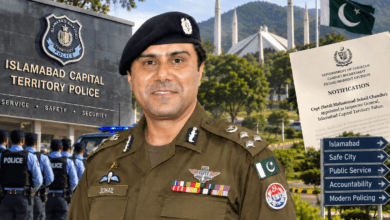
A New Striking Force for the Capital
ASP Mehak Fatima's Capital Patrol has spread its footprint across all of Islamabad, 500+ personnel, 186 bikes, 48 electric vehicles, and a city that no longer feels safe

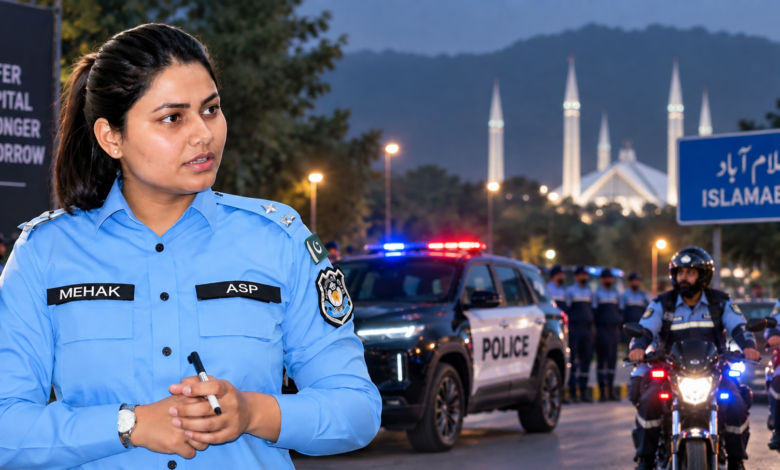
ISLAMABAD: At the head of the largest street force Islamabad Police has ever fielded stands an officer of the 50th Common Training Programme.
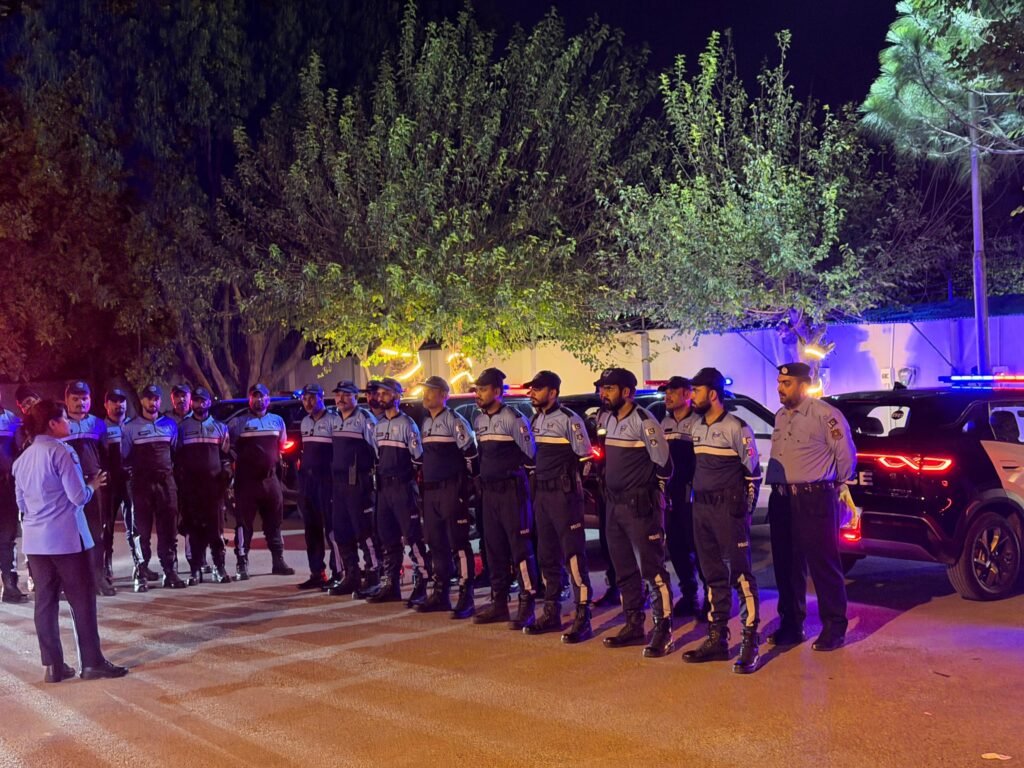
Assistant Superintendent of Police Mehak Fatima commands more than 500 personnel, 186 motorcycles, 48 BYD electric vehicles and 16 patrol cars, a formation whose footprint now extends across the entire Islamabad Capital Territory, from the service lanes behind Blue Area to the unpaved approaches of Tarnol and the ridge roads above Bhara Kahu.
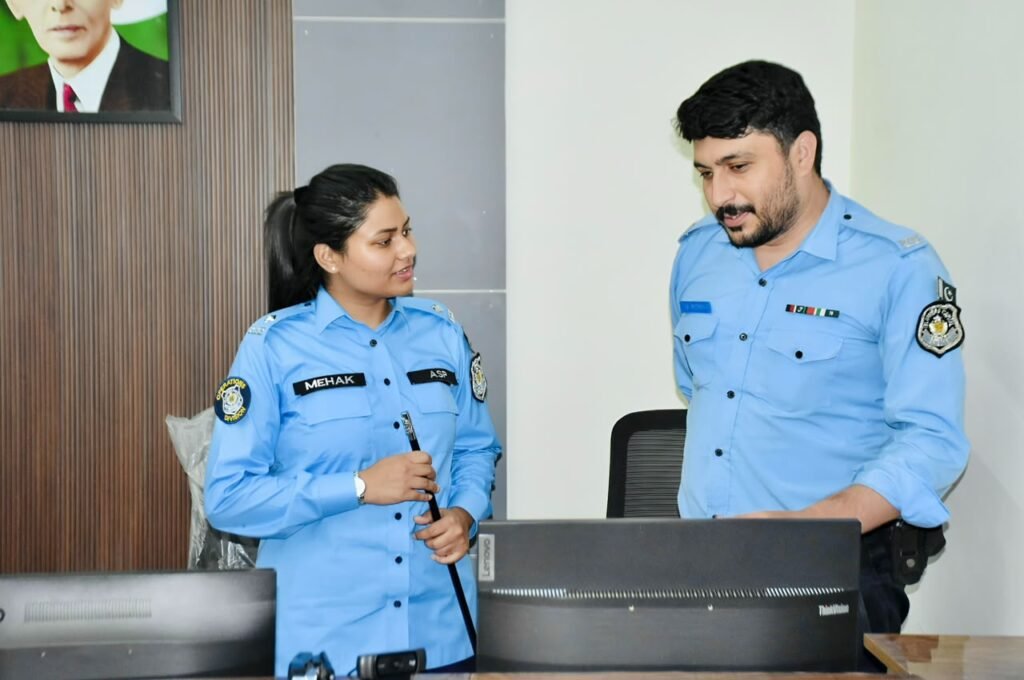
It is, by any measure, the most exposed operational command in the federal capital. It was created in the shadow of two suicide bombings, a crime debate in which the police and the public are not describing the same city, and a government that has concluded the answer is more officers, more machines and more cameras.
All of it now runs through one desk.
The Force at a Glance
| Manpower | 500+ |
| Motorcycles | 186 |
| BYD electric vehicles | 48 |
| Patrol cars | 16 |
| Total vehicles | 250 |
| Patrol composition | Two-officer units |
| Equipment | Body-worn cameras, all personnel |
| Area of responsibility | Entire Islamabad Capital Territory |
| Commander | ASP Mehak Fatima, PSP |
The Command
The scale of what ASP Mehak Fatima has been handed is easy to underestimate until it is set against the rest of the country. A force of 500-plus personnel exceeds the operational strength of several district police formations in Pakistan. It is not a squad, a cell or a pilot project. It is a standing body of beat officers, mounted and mobile, deployed across a capital of nearly two million people and 906 square kilometres of territory that runs from dense urban sectors to rural union councils.
The duties that come with it are unglamorous and unforgiving. Night-shift rosters for hundreds of constables and head constables. Beat allocation across every police station jurisdiction in the territory. Fleet discipline across 250 vehicles. And, above all, personal accountability for every distress call her patrols fail to reach in time, and for the conduct of 500 officers carrying stop-and-search powers in a city whose relationship with its police has been tested to breaking point more than once in the past two years.
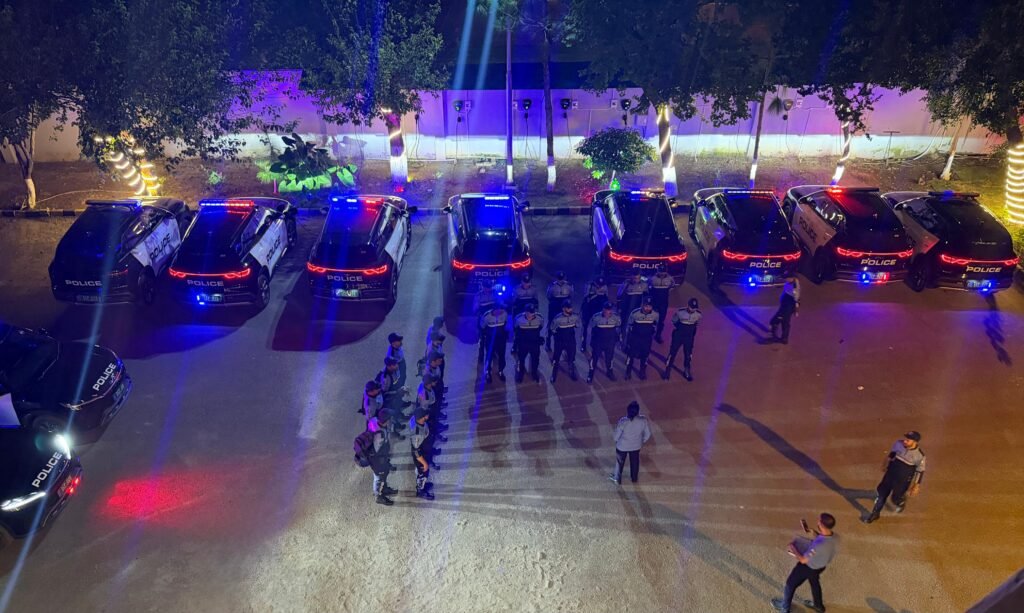
Patrols operate in two-officer units. It is the oldest principle in street policing and the most reliably ignored one in this country: a lone officer on a beat is a witness, while a pair is an intervention. Pairing doubles the deterrent value of every deployment, halves the risk to the individual officer, and creates the internal check that makes body-camera footage meaningful rather than decorative.
ASP Mehak Fatima will be judged on none of the things that usually attach to a posting of this visibility. She will be judged on minutes, recoveries and complaints. That is the assignment she accepted.
The Fleet: 250 Vehicles, Built Over Six Months
The Capital Patrol’s hardware did not appear in a single ceremony. It was assembled in stages across 2026, and the electric component has made Islamabad Police the most aggressive public-sector adopter of electric mobility in Pakistan and the operator of one of the largest electric police fleets in South Asia.
The sequence:
April 6, 2026: Prime Minister Shehbaz Sharif handed over the force’s first New Energy Vehicle fleet, comprising BYD Atto 2 and BYD Sealion 7 models supplied through Mega Motor Company, BYD’s official partner in Pakistan. It was the first operational adoption of an NEV fleet by any federal department in the country. Then-Inspector General Ali Nasir Rizvi and Chief Traffic Officer Muhammad Sarfraz Virk attended.
July 2026: A further delivery expanded the fleet under the department’s ongoing electrification programme, with Chief Traffic Officer Kainat Azhar Khan noting the additional units would strengthen operational mobility while lowering fuel costs.
August 2026: Thirty additional vehicles were inducted, including further electric units, for distribution among police stations across the capital.
September 8, 2026: The Prime Minister handed over 50 BYD electric vehicles under the “Capital Patrols Electric Vehicles” programme, earmarked for Capital Patrol Unit operations and traffic management. All 50 are BYD Atto 2 sub-compact SUVs.
The Electric Component
| Model | BYD Atto 2 (sub-compact SUV) |
| Unit price | Rs 7.29 million |
| Approx. fleet value (48 units) | Rs 350 million |
| Motor | Front-mounted permanent magnet synchronous, 130 kW / 290 Nm |
| Battery | 45.12 kWh LFP Blade Battery |
| Range | Up to 380 km (NEDC) |
| Charging | 30–80 per cent in 30 minutes |
| 0–100 kph | 7.9 seconds |
| Projected fuel saving | Rs 34 million per month |
| Cost recovery period | Approx. 10.5 months per vehicle |
The economics were briefed to the Prime Minister at the September handover: Rs 34 million a month in avoided fuel costs, with each vehicle paying for itself through fuel savings in roughly ten and a half months. Against a fleet outlay of approximately Rs 350 million for the electric component, that is an unusually short payback period for any public-sector capital purchase in Pakistan.
The operational advantages are less discussed and more interesting to a patrol commander. A 7.9-second sprint to 100 kph places these vehicles well ahead of the conventional sedans that have carried Islamabad’s patrol duties for two decades. A 380-kilometre range covers a full double shift across the territory without a charging stop. And an electric vehicle closing on a suspect car after midnight does not announce its approach a tactical edge, not an environmental talking point.
The Prime Minister framed Islamabad Police as a role model for other cities. Whether that framing survives contact with duty cycles, charging access, maintenance support and honest operating-cost tracking is the open question. A police fleet runs around the clock; it does not sit in a garage overnight. The Capital Patrol is, in effect, Pakistan’s largest live test of whether electric vehicles hold up under continuous institutional use.
Why Her Force Is Built on Bikes, Not Cars
The single most consequential choice in the unit’s structure is its ratio: 186 two-wheelers against 64 four-wheelers. That is not a budgetary compromise. It is a reading of where crime in Islamabad actually happens.
The capital’s offending map is not a highway map. It is service lanes, market rears, green belts, katchi abadis and half-built sectors where a patrol car is an obstacle and a motorcycle is an instrument. Snatchers work in pillion pairs on bikes. They are intercepted, when they are intercepted at all, by bikes.
The 186 motorcycles are what give the Capital Patrol its actual footprint. Sixty-four four-wheelers can cover arterial roads. Only a two-wheeler force of this size can put a uniformed presence inside the lanes where the offences occur and do it repeatedly, on a schedule, across every police station jurisdiction in the territory.
Fifteen Months That Changed the Capital’s Threat Map
Islamabad spent a decade as the exception. While Khyber Pakhtunkhwa and Balochistan absorbed the bulk of Pakistan’s militant violence, the federal capital stayed insulated behind the Red Zone’s checkpoints, paramilitary deployments and access controls.
That exception ended on 11 November 2025, when a suicide bomber who failed to enter the District Judicial Complex in G-11/4 waited outside the gates for ten to fifteen minutes before detonating beside a parked Islamabad Police vehicle, killing 12 people and injuring dozens. Tehreek-e-Taliban Pakistan’s Jamaat-ul-Ahrar faction claimed the attack.
Three months later, on 6 February 2026, a bomber opened fire at the entrance of an imambargah in Tarlai Kalan on the capital’s outskirts, then detonated his vest inside the congregation during Friday prayers. At least 31 worshippers were killed and more than 160 injured. Islamic State–Pakistan Province claimed responsibility. It was the deadliest terrorist attack in Islamabad since the 2008 Marriott hotel bombing.
The verdict drawn at the time was blunt: two major attacks within three months demonstrated militant penetration of a high-security urban area that had remained comparatively peaceful, and the relative calm may itself have produced lowered vigilance exposing vulnerabilities in the capital’s layered security architecture, particularly outside the heavily protected Red Zone.
Outside the Red Zone. That is ASP Mehak Fatima’s operational brief in three words. The Red Zone has never been the weakness. G-11, Tarlai Kalan, Bhara Kahu, Tarnol, Koral, the Industrial Area and the sprawling peri-urban belt are where the capital’s security is genuinely thin and where a mounted formation of 500 is meant to change the arithmetic.
The Street-Crime Argument Nobody Has Settled
The second driver is less dramatic and, for most residents, far more immediate.
Islamabad Police told the public in May that overall crime had fallen 36 per cent in the first four months of 2026 against the same period of 2025, with a 50 per cent reduction recorded in April alone. The force said 447 members of 192 criminal gangs involved in robbery, street crime, car theft and motorcycle theft had been arrested, and that stolen property worth more than Rs 120 million had been recovered.
The Official Record: Jan–April 2025 vs Jan–April 2026
| Offence | 2025 | 2026 | Change |
|---|---|---|---|
| Street robbery / mobile snatching | 377 | 192 | −185 |
| Motorcycle theft | 1,001 | 642 | −359 |
| Car theft | 151 | 34 | −117 |
| Motorcycle snatching | 129 | 92 | −37 |
The counter-picture is equally documented. In early April, official data recorded more than 60 serious offences in a single week four murders, two abductions, five thefts and 49 cases of robbery and street mugging alongside the killing of a prominent businessman in an affluent sector.
The gap between a headline percentage and a weekly incident log is where public confidence has been lost. Whichever set of figures is closer to the truth, the conclusion has already been reached in the corridors above ASP Mehak Fatima’s office: the capital needs uniformed officers physically on the street, visible, mobile and recorded.
Delivering that is now her department.
The Command Layer Above Her
The Capital Patrol does not stand alone. On the same day the electric fleet was handed over, Interior Minister Mohsin Naqvi inaugurated Islamabad Police’s Command, Control, Communication and Coordination Centre, which brings Safe City and the force’s other operational systems onto a single platform and allows the Inspector General to monitor and direct the capital’s law-and-order situation from his own office, with AI-based tools intended to sharpen response times and field-force monitoring.
Days later, the command itself changed. Captain (Retd) Muhammad Sohail Chaudhry formally took charge as Inspector General on 15 September, succeeding Syed Ali Nasir Rizvi, who moved to head the National Cyber Crime Investigation Agency. Chaudhry arrives with a field-operations record built across CTO Lahore, CPO Faisalabad, DIG Operations Lahore, DIG CTD Punjab and RPO Multan, and has placed public safety, crime prevention and the rule of law at the top of his agenda.
Beneath that command sits the deepest structural expansion in the force’s history: more than 8,000 new posts approved, a 69 per cent increase in sanctioned strength, recruited for the first time on a cadre-wise basis so that personnel remain in their assigned wing rather than being rotated out. Roughly 790 of those posts are earmarked for the patrol cadre.
That last detail is the one ASP Mehak Fatima has the greatest stake in. Every previous patrolling experiment in this capital from the Cycle Patrol Unit onward was raised with fanfare and then quietly hollowed out within eighteen months as its manpower was pulled away for VIP security, protest duty and court deployments. No one ever announced the death of those units, because no one ever took a decision; the personnel simply stopped arriving.
Cadre-wise recruitment is the first structural attempt to stop that happening again. Whether the firewall holds will determine whether the force she commands still exists in recognisable form a year from now.
What Will Decide Whether It Works
Three metrics, none of them ceremonial.
Response time. Islamabad Police already claims a five-to-seven-minute response through Safe City-integrated Rescue-15 operations. If 186 motorcycles do not measurably improve on that figure in the outer sectors — Bhara Kahu, Tarnol, Koral, Humak, Shehzad Town the fleet is decoration.
Recovery rate. Arrests are a weak proxy for public safety. Residents measure their police by whether a snatched phone or a stolen motorcycle ever comes back.
Complaints against her own personnel. A 500-strong force with stop-and-search powers in a city already tense about checkpoints can generate a crisis of its own making. The body cameras exist precisely for this, and the footage-retention policy attached to them will matter more than their purchase price.
Those are the terms ASP Mehak Fatima has accepted. She has inherited the most visible and most exposed command in the federal capital at a moment when the city’s tolerance for security failure has collapsed, and when the distance between an official crime statistic and a citizen’s sense of safety is the widest it has been in years.
The footprint is laid. Every sector of Islamabad now falls inside it. What happens within that footprint over the coming months is, more than anyone else’s, her responsibility and the city will measure her by minutes, not by ceremonies.