McDonald’s Rawalpindi 16% Card Tax Sparks Questions Over PRA Rules
A customer says he was charged 16% Punjab sales tax on a credit-card transaction at McDonald’s Jinnah Park despite the current 8% rate for restaurant payments made digitally, while restaurant staff reportedly cited a 2022 PRA permission letter.

RAWALPINDI: Questions have emerged over the sales tax charged on a credit-card transaction at McDonald’s Jinnah Park, Rawalpindi, after a customer publicly claimed that he was charged 16% despite Punjab’s current reduced tax rate for digital restaurant payments.
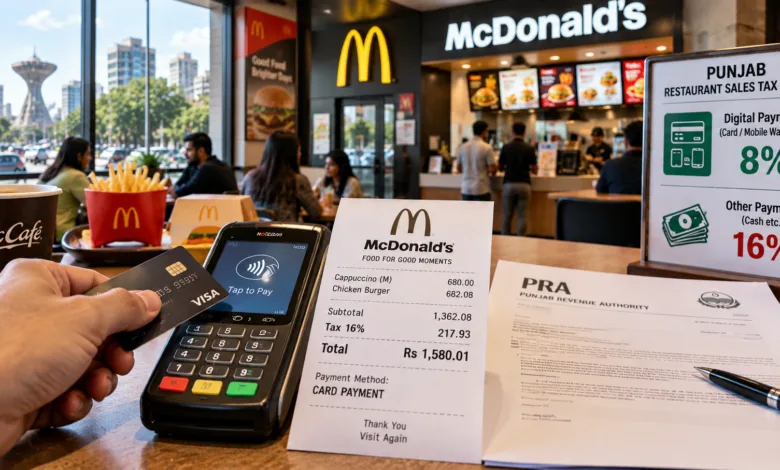
Nasir Javed shared photographs of what he described as his restaurant receipt and a Punjab Revenue Authority (PRA) letter, questioning why the higher rate had been applied to his card transaction.
According to the receipt visible in the post, dated September 18, 2026, the total sale value was shown as Rs1,362.08, while tax at 16% amounted to Rs217.93, bringing the total bill to approximately Rs1,580. The receipt also identifies the transaction as a credit-card sale.
The issue is notable because Punjab’s current tax structure provides a lower rate for qualifying digital payments at restaurants.
Under the amended Punjab Sales Tax on Services framework, restaurant services paid for through debit or credit cards, mobile wallets or QR scanning are subject to an 8% rate without input-tax adjustment, while the rate for other modes of payment is 16%.
The revised digital rate became effective on July 1, 2026. Before that date, the corresponding digital-payment rate was 5%. The Punjab Revenue Authority also publicly confirmed in July that restaurant and hotel customers paying digitally would face an 8% tax compared with 16% for cash payments.
Customer Questions 2022 PRA Permission
Javed claimed that after questioning the charge, the restaurant manager told him that McDonald’s outlets in Rawalpindi and Islamabad were permitted to charge the 16% PRA rate. According to his account, the manager produced a PRA letter from 2022 in support of the position.
A photograph attached to the post appears to show a PRA document dated September 1, 2022, addressed to M/S Size Foods (Pvt) Limited. The photographed document appears to concern permission for charging sales tax at 16% instead of the then-applicable reduced rate where payment was received through debit or credit cards, mobile wallets or QR scanning.
The customer consequently questioned whether the 2022 permission remains valid following the subsequent changes to Punjab’s tax regime.
That question is important because the provincial framework has since changed. The Punjab Finance Act 2026 increased the reduced digital-payment rate for restaurants from 5% to 8%, while retaining 16% for other payment methods. Independent reporting quoting PRA officials has also confirmed that the 8% digital rate is currently in force.
However, Islamabad Tribune has not independently established whether the photographed 2022 PRA permission has subsequently been withdrawn, superseded or remains applicable specifically to the company concerned. The existence of a general 8% rate therefore does not, by itself, establish that the 16% charge shown on this particular receipt was unlawful.
The matter would require clarification from the Punjab Revenue Authority on whether any company-specific permission issued under the previous tax framework continues to override or modify the digital-payment rate introduced from July 1, 2026.
The customer has also questioned why such an exception, if currently valid, would not be prominently disclosed to customers before payment.
PRA has encouraged restaurant customers to use digital payments and obtain proper tax invoices. Official sources quoted by Associated Press of Pakistan in July said restaurant and hotel services attract 16% on cash payments and 8% on digital payments under the new system.
The episode therefore raises a specific regulatory question for PRA: does the 2022 permission shown by the restaurant remain valid under Punjab’s post-July 2026 tax framework?
Until PRA or the restaurant operator provides clarification, the validity and present legal effect of the photographed letter should not be treated as conclusively established.