President Issues Gazette Enforcing Emergency Rule in KP
President Asif Ali Zardari invokes Articles 232 and 234 of the Constitution, ending the provincial cabinet's tenure and transferring provincial assembly powers to Parliament with immediate effect.

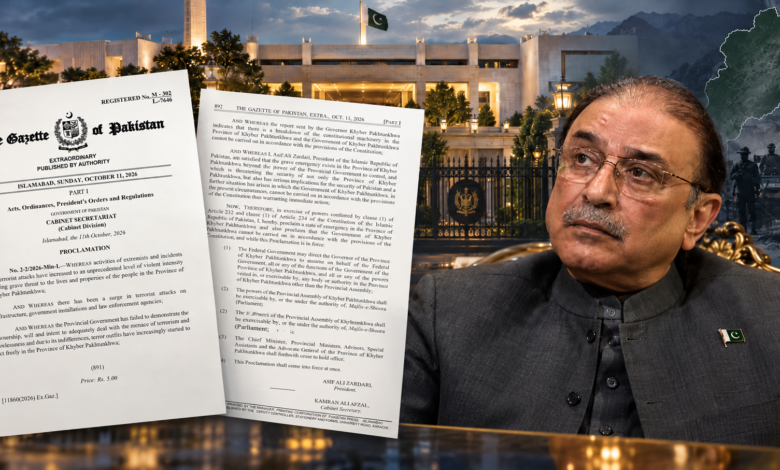
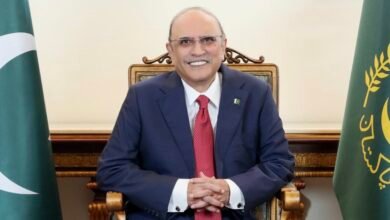
ISLAMABAD, October 11, 2026: The federal government has formally issued a gazette notification enforcing a state of emergency in Khyber Pakhtunkhwa following a presidential proclamation signed by President Asif Ali Zardari under Articles 232(1) and 234(1) of the Constitution of Pakistan.
Emergency Notification Published in Official Gazette
The proclamation, published in the Extraordinary Gazette of Pakistan on Sunday, October 11, 2026, immediately ends the tenure of the provincial chief minister, ministers, advisers, special assistants and advocate general, while establishing a constitutional framework for federal control over the province’s administration.
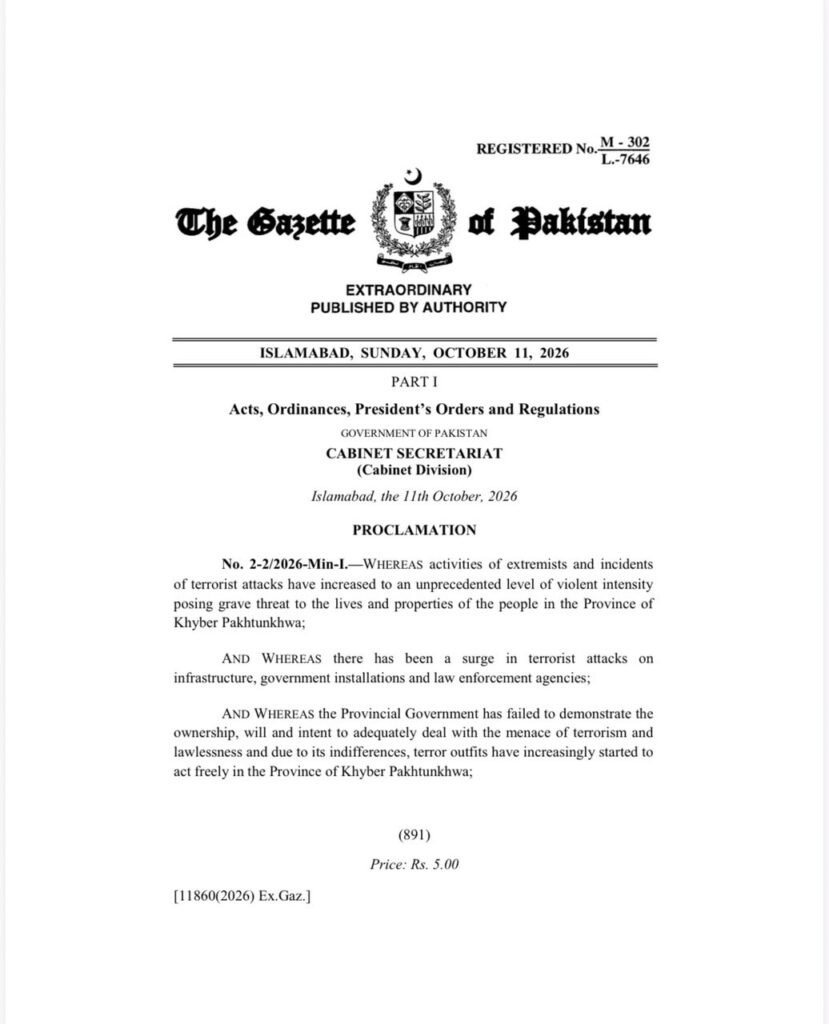
According to the gazette notification issued by the Cabinet Secretariat’s Cabinet Division, the emergency has been imposed in response to a serious deterioration in the security situation and what the federal government describes as a breakdown of constitutional governance in Khyber Pakhtunkhwa.
The presidential order, bearing notification number 2-2/2026-Min-I, states that incidents involving extremist activities and militant attacks have intensified to unprecedented levels, creating serious risks to public safety and property across the province.
The notification further identifies an increase in attacks targeting infrastructure, government installations and law enforcement agencies as major factors behind the decision.
The federal government maintains that the provincial administration failed to demonstrate sufficient commitment and effectiveness in addressing the deteriorating security situation, allowing armed groups to expand their activities.
These assessments are presented in the proclamation as the federal government’s grounds for invoking extraordinary constitutional powers.
Governor’s Report Cites Constitutional Breakdown
A central justification for the presidential decision is a report submitted by the Governor of Khyber Pakhtunkhwa.
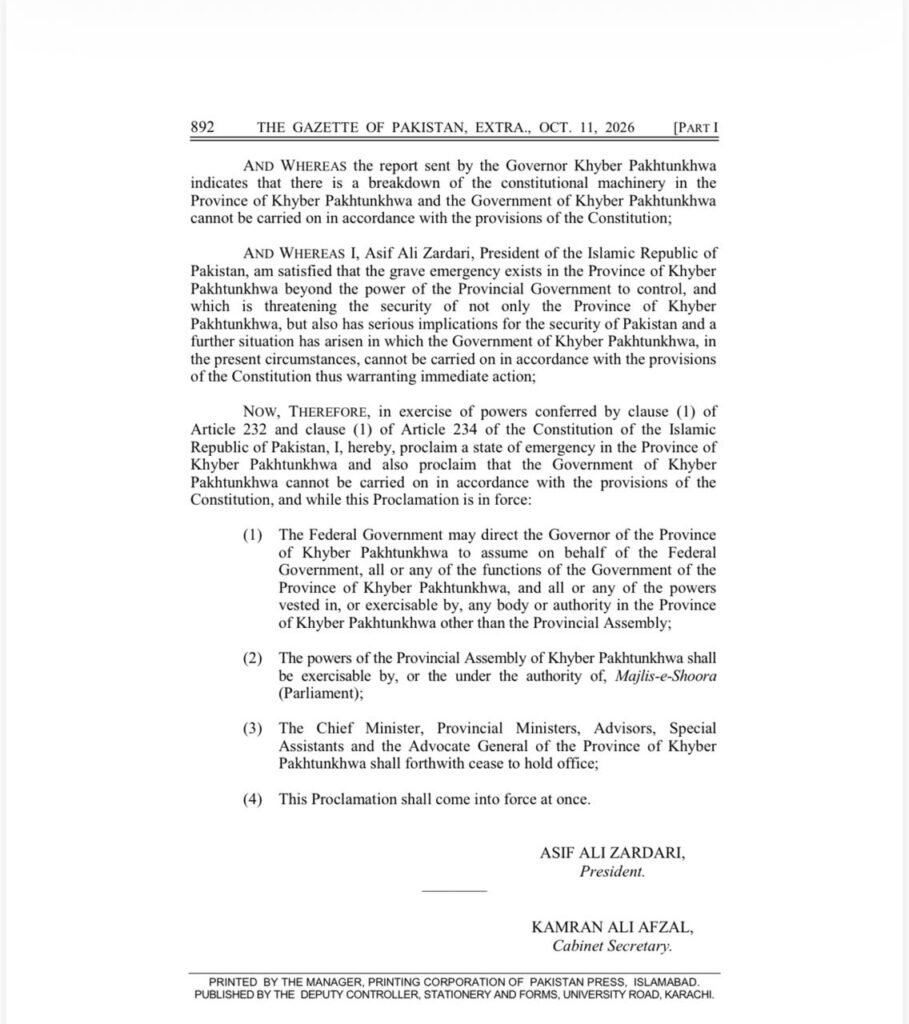
According to the proclamation, the governor’s report concluded that the constitutional machinery in the province had broken down and that the provincial government could no longer function in accordance with constitutional requirements.
President Zardari stated in the proclamation that he was satisfied an extraordinary situation existed beyond the provincial government’s ability to control.
The notification also describes the circumstances as having implications for the security of Pakistan as a whole, requiring immediate federal intervention.
Federal Government Empowered to Transfer Administrative Powers
Under the presidential proclamation, the federal government may direct the Governor of Khyber Pakhtunkhwa to assume all or selected functions of the provincial government on its behalf.
The governor may also exercise powers previously vested in provincial authorities and institutions, subject to the federal government’s directions and the terms of the proclamation.
This arrangement enables federal authorities to exercise executive control through the governor rather than the elected provincial cabinet.
The precise scope of the governor’s administrative responsibilities will depend on the powers assigned through federal directions.
Provincial Assembly Powers Shift to Parliament
One of the most significant provisions of the presidential order concerns the Khyber Pakhtunkhwa Assembly.
The gazette states that the powers of the provincial assembly shall be exercisable by, or under the authority of, Majlis-e-Shoora (Parliament).
This transfers the exercise of provincial legislative authority to the federal parliamentary framework during the proclamation.
The notification does not expressly dissolve the provincial assembly. Instead, it places the exercise of its powers under Parliament’s authority.
Chief Minister and Provincial Cabinet Cease to Hold Office
The proclamation expressly directs that the Chief Minister of Khyber Pakhtunkhwa, provincial ministers, advisers, special assistants and the advocate general shall immediately cease to hold office.
Consequently, the Pakistan Tehreek-e-Insaf-led provincial government, headed by Chief Minister Sohail Afridi, has lost its executive authority under the emergency arrangements.
The move represents a major constitutional and administrative change in Khyber Pakhtunkhwa, replacing the elected provincial executive with a system of federal oversight.
Federal Cabinet Recommended Emergency Measures
The presidential proclamation followed a special meeting of the federal cabinet chaired by Prime Minister Shehbaz Sharif in Islamabad.
During the meeting, cabinet members reviewed reports concerning the province’s security situation and the performance of the provincial administration.
The cabinet subsequently recommended that the prime minister advise the president to exercise constitutional powers under Articles 232 and 234.
Following the prime minister’s formal advice, President Zardari approved the emergency measures, and the government proceeded with their notification in the official gazette.
Constitutional Approval and Parliamentary Oversight
Article 232 of the Constitution provides for an emergency proclamation when the country’s security, or that of any part of it, faces a grave threat, including internal disturbances beyond a provincial government’s capacity to control.
The provision also establishes parliamentary approval requirements. Where the president acts without a provincial assembly resolution, the proclamation must be placed before both houses of Parliament for approval within ten days.
Article 234 addresses situations in which a provincial government cannot be conducted in accordance with the Constitution.
Under Article 234(3), a proclamation concerning the failure of constitutional machinery must be placed before a joint parliamentary sitting and requires approval to remain effective beyond two months. Extensions are subject to constitutional limits.
These provisions will be important in determining the parliamentary scrutiny and continuation of the emergency arrangements.
PTI Rejects Emergency Decision
The emergency has also drawn strong opposition from Pakistan Tehreek-e-Insaf.
PTI Chairman Barrister Gohar Ali Khan has condemned the decision as undemocratic and called on the federal government to reconsider it.
He maintains that the electoral mandate of Khyber Pakhtunkhwa’s people must be respected and that provincial autonomy should not be undermined.
The party has argued that security challenges require national cooperation and constitutional dialogue rather than confrontation between federal and provincial authorities.
Proclamation Takes Immediate Effect
The presidential proclamation states that its provisions come into force immediately.
The document carries the name of President Asif Ali Zardari and is issued through the Cabinet Division under Cabinet Secretary Kamran Ali Afzal.
Its publication in the Extraordinary Gazette formally records the federal government’s emergency arrangements for Khyber Pakhtunkhwa, marking a major change in the province’s constitutional and administrative governance.