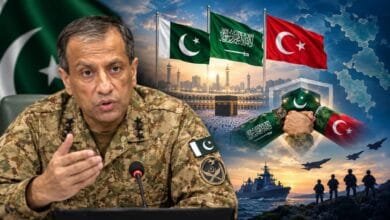
277th Corps Commanders’ Conference Warns Against May 9-Like Unrest
277th Corps Commanders’ Conference reviews terrorism, internal stability and regional security, backs intensified intelligence-based operations and welcomes Pakistan-Saudi Arabia-Türkiye defence cooperation.

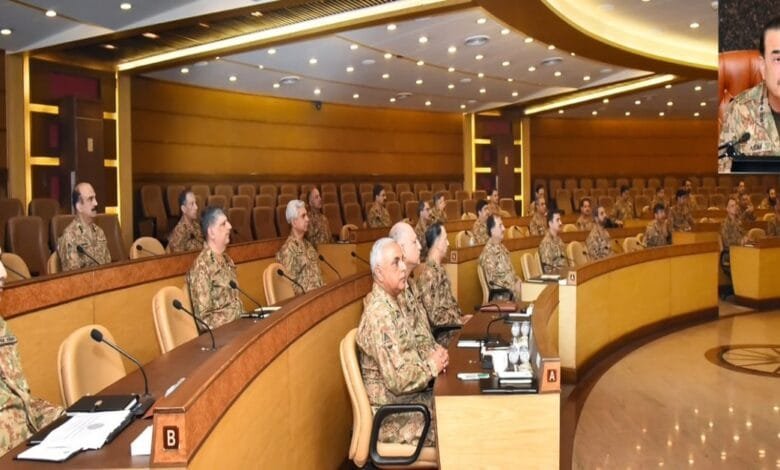
RAWALPINDI: Pakistan’s military leadership has reaffirmed its commitment to maintaining internal stability and strengthening counterterrorism operations, warning that any attempt to create unrest resembling the events of May 9 would be dealt with decisively under the law.
The position was expressed during the 277th Corps Commanders’ Conference held in Rawalpindi under the chairmanship of Field Marshal Syed Asim Munir, Chief of Army Staff and Chief of Defence Forces, according to the Inter-Services Public Relations (ISPR).
Counterterrorism Operations Reviewed
The forum reviewed the country’s internal and external security environment and offered Fateha for members of the armed forces, law-enforcement agencies and civilians who lost their lives in defence of the country.
Participants paid tribute to their sacrifices and reviewed ongoing counterterrorism operations across the country.
According to ISPR, the military leadership maintained that Pakistan retains the right to undertake targeted action against terrorism emanating from Afghanistan. The conference also attributed responsibility to the Taliban leadership for what it described as allowing terrorism against Pakistan from Afghan territory and alleged links between such groups and India.
The forum praised law-enforcement agencies for intelligence-based counterterrorism operations and stressed that security operations alone would not be sufficient to eliminate terrorism.
Participants called for improved governance and administrative measures at the grassroots level, stronger public communication on the causes and dynamics of terrorism, disruption of the nexus between criminal networks and militant elements, and enhanced capabilities of police forces.
The conference described internal stability as critical for Pakistan and said any attempt to create violent unrest or circumstances similar to May 9 would be addressed decisively and in accordance with the law.
Regional Security Discussed
Regional security also featured prominently in the discussions.
The commanders welcomed the Makkah Joint Defence Agreement between Pakistan, Saudi Arabia and Türkiye, describing it as an important development in longstanding strategic relations and defence cooperation among the three countries.
The agreement, signed in Makkah on August 7, establishes a collective-defence framework under which an armed attack against one of the three countries is regarded as an attack against all. Pakistan has officially described the arrangement as defensive in nature and not directed against any particular country.
The conference also condemned Houthi attacks against Saudi Arabia and expressed solidarity with the Kingdom, while reiterating Pakistan’s commitment to the protection and sanctity of the Two Holy Mosques.
Kashmir, Defence Capabilities Reviewed
On Kashmir, participants reiterated Pakistan’s position that the dispute should be resolved in accordance with United Nations Security Council resolutions and the aspirations of the Kashmiri people.
Concluding the conference, Field Marshal Munir directed that intelligence-based operations should continue to be strengthened.
He also called upon military formations to further improve their defence capabilities through the acquisition and integration of modern technologies, enhanced training and coordination across different domains of warfare.
The Field Marshal said the armed forces, backed by the nation, remained prepared to safeguard Pakistan’s sovereignty, territorial integrity and national security.