Social Media Erupts Over IG, Chief Commissioner’s Buggy Ride
Interior Minister Mohsin Naqvi says the ceremonial carriage was intended for the chief guest and that IG Islamabad and Chief Commissioner Sohail Ashraf used it only after being instructed to begin the delayed Independence Day programme, as online critics contrasted the spectacle with the Norwegian foreign minister’s low-key arrival on a commercial flight.

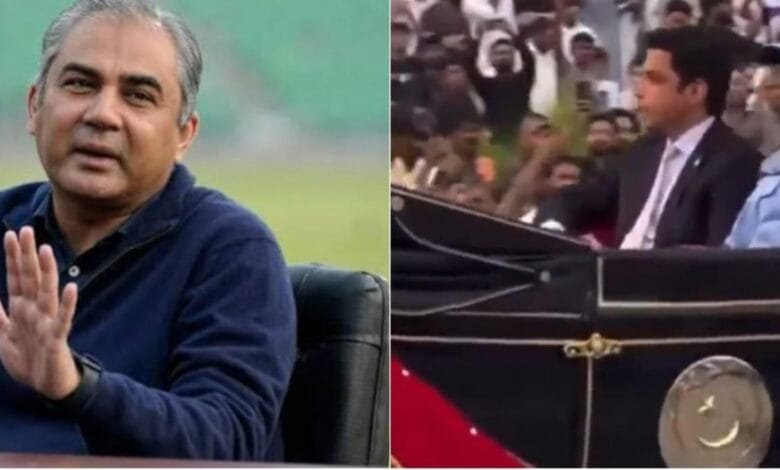
ISLAMABAD: A ceremonial buggy ride by Islamabad’s top police and administrative officials during the Independence Day City Parade at D-Chowk has triggered a heated social-media debate, prompting Interior Minister Mohsin Naqvi to publicly defend the officers and acknowledge that what happened was “not appropriate.”
Buggy Ride Sparks Social Media Debate
The controversy emerged after visuals from the August 14 Islamabad City Parade showed Inspector General of Police Islamabad Syed Ali Nasir Rizvi and Chairman CDA/Chief Commissioner Islamabad Sohail Ashraf arriving in a ceremonial carriage. The parade was organised jointly by the Capital Development Authority and Islamabad Capital Territory Administration as a major public Independence Day celebration at D-Chowk. Reports ahead of the event said organisers expected up to 15,000 people, with proceedings scheduled to begin after 5pm.
As footage circulated online, some social-media users criticised what they described as colonial-era or VIP-style optics for senior public officials. The criticism became particularly sharp after users began contrasting the buggy arrival with Norwegian Foreign Minister Espen Barth Eide’s visit to Islamabad.
Comparison With Norwegian Foreign Minister’s Arrival
Eide arrived in Islamabad on a commercial flight during his August 13-14 official visit and was seen carrying his own luggage, an image that also attracted considerable attention online. His visit was the first by a Norwegian foreign minister to Pakistan in a decade.
Against that backdrop, critics used the two sets of visuals to make a broader argument about official culture, austerity and symbolism. Some characterised the D-Chowk carriage as reminiscent of colonial officialdom, while others questioned whether such ceremonial treatment was appropriate for serving police and civil-administration officers.
Journalist Absar Alam was among those cited in the online criticism, while other users questioned the use of a ceremonial carriage and drew comparisons with the conduct of senior officials in European countries.
Naqvi Explains Circumstances Behind Buggy Ride
Interior Minister Mohsin Naqvi subsequently stepped in with a detailed explanation, saying neither the IG Islamabad nor the Chief Commissioner was responsible for the situation.
“I know what happened was not appropriate,” Naqvi said, before stressing that the two officers should not be blamed for it.
According to Naqvi, the chief guest and the interior minister were delayed because of a meeting between the President and Prime Minister. Members of the public had been waiting at the venue since around 5pm, and by approximately 6pm it had become apparent that the delay would continue.
Naqvi said the officers were therefore instructed to start the programme rather than keep citizens waiting. He further explained that the buggy had originally been designated for the chief guest and that the officers were supposed to accompany the chief guest.
The minister maintained that both officials had initially been reluctant to begin the programme in the absence of the chief guest and other senior figures, but were specifically directed to proceed because of the waiting crowd.
Debate Over Official Ceremonial Culture
Naqvi also thanked Islamabad residents for their participation in the August 14 celebrations, saying citizens had helped turn the event into a major Independence Day celebration.
The clarification shifts an important part of the controversy from the individual officers to the circumstances and protocol surrounding the event. However, the episode has continued to generate discussion online over the symbolism of official ceremonies and the public expectations surrounding simplicity in government.
The comparison with Norway’s foreign minister remains particularly striking in the online conversation: Eide was in Islamabad on an official two-day visit involving high-level talks on bilateral relations, trade, investment and other issues, yet his commercial-flight arrival and handling of his own luggage were widely highlighted as an example of understated official conduct.
While such social-media comparisons reflect opinions rather than evidence of wrongdoing, the controversy illustrates how ceremonial optics involving senior public officials can quickly become a matter of public scrutiny — particularly when competing images of official privilege and simplicity circulate side by side.