Student’s Death Brings Stray Dog Issue to Court
Islamabad High Court directs CDA chairman and chief commissioner to decide a petition seeking urgent measures after the reported death of International Islamic University student Sufyan Abbasi following a stray dog bite.


ISLAMABAD, November 19, 2026: The Islamabad High Court (IHC) has directed the chairman of the Capital Development Authority (CDA) and the Islamabad chief commissioner to consider and decide a petition seeking urgent action over the growing presence of stray dogs in the federal capital, following the reported death of a student at the International Islamic University Islamabad (IIUI).
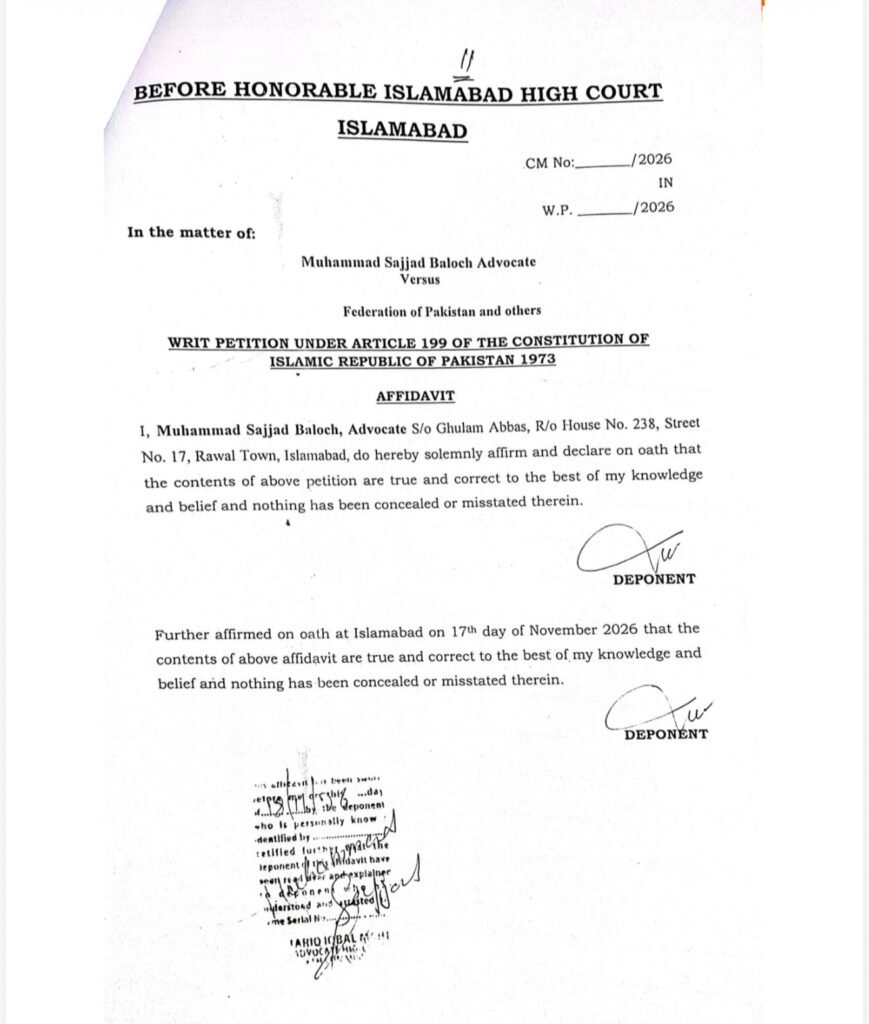
Justice Ayaz Shaukat issued the directions while hearing a petition filed by Advocate Muhammad Sajjad Baloch, who appeared in person and raised concerns about public safety, the availability of anti-rabies treatment and the responsibilities of Islamabad’s civic authorities.
The court forwarded the petition to the CDA chairman and chief commissioner for consideration and a decision, rather than directly ordering the removal of stray dogs.
During the hearing, the petitioner referred to the death of an IIUI student who had reportedly been bitten by a stray dog near his university hostel.
Justice Shaukat observed that appropriate directions could be issued to ensure the matter was addressed without unnecessary delay.
University Student’s Death Raises Public Safety Concerns
The petition specifically refers to Sufyan Abbasi, a fifth-semester Information Technology student at the International Islamic University Islamabad, who reportedly died on November 17, 2026, after developing serious health complications following a stray dog bite.
According to the petition, the student was bitten outside a university hostel during the night between October 10 and 11.
The petitioner stated that rabies was diagnosed on November 15, two days before the student’s death.
Separate media reports identified the student as a resident of Dhirkot in Azad Jammu and Kashmir and confirmed that he had been studying in the university’s Information Technology Department.
The incident prompted concern among fellow students, who alleged that the presence of stray dogs around university hostels had remained a longstanding safety issue.
Students subsequently protested and demanded an investigation into the circumstances surrounding his death, as well as measures to protect residents of university hostels.
The student’s complete medical treatment record and the circumstances surrounding his reported rabies diagnosis have not been independently established through publicly available official medical documents.
Petition Names Six Government Authorities
The constitutional petition was filed under Article 199 of the Constitution of Pakistan.
It named six respondents: the Federation of Pakistan through the Ministry of Interior, the Ministry of National Health Services, Regulations and Coordination, the Capital Development Authority, the Islamabad Chief Commissioner, the Deputy Commissioner and the Metropolitan Corporation Islamabad.
The petitioner argued that the increasing presence of stray dogs in residential neighbourhoods, public parks, roads and other areas of Islamabad had become a serious public safety concern.
He maintained that schoolchildren, elderly residents and pedestrians were particularly vulnerable.
The petition also raised concerns about the reported shortage of anti-rabies vaccines in government hospitals, although no official stock figures or hospital inventory records were included in the material reviewed.
Petitioner Seeks Removal Within Ten Days
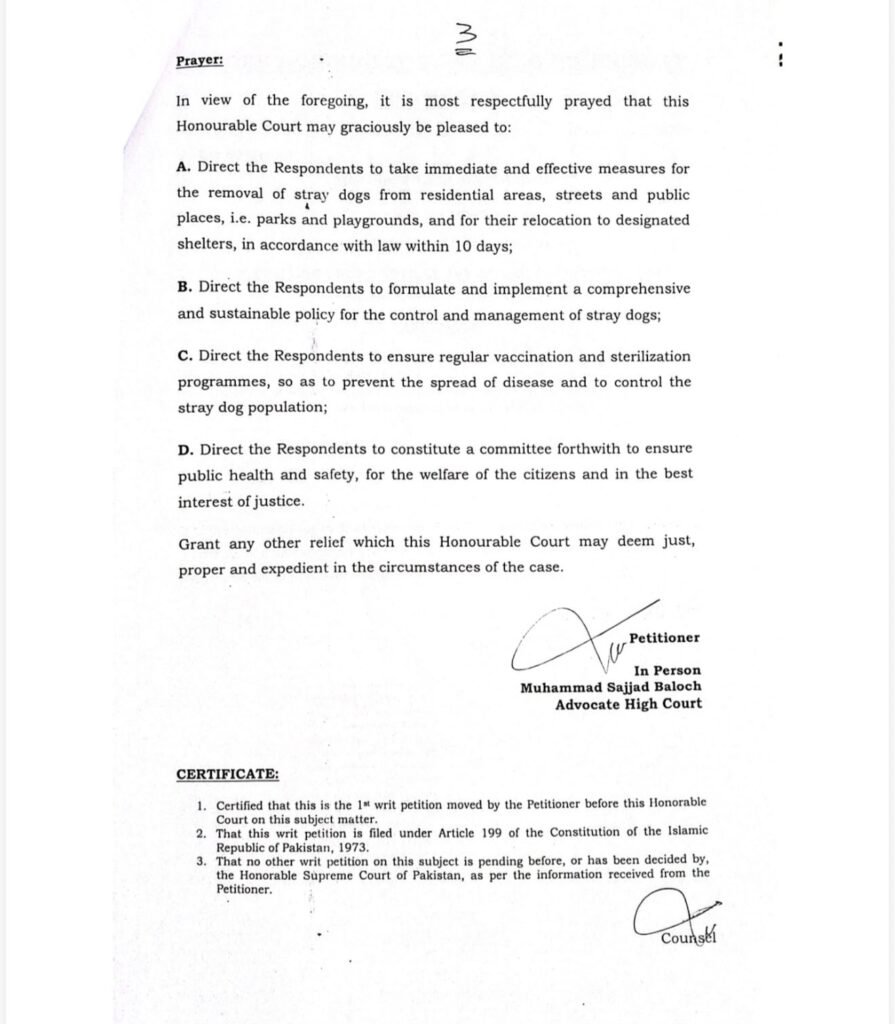
In the written petition, Advocate Sajjad Baloch requested the court to direct the relevant authorities to remove stray dogs from residential areas, streets, parks and playgrounds and relocate them to designated shelters in accordance with the law within ten days.
He also sought directions for the formulation and implementation of a comprehensive and sustainable policy for controlling and managing the stray dog population.
The petition called for regular vaccination and sterilisation programmes to reduce the risk of disease transmission and manage the stray dog population.
Another request concerned the establishment of a committee responsible for monitoring public health and safety measures.
The petitioner argued that the alleged failure of the authorities to address the situation affected fundamental rights guaranteed under Articles 9, 14 and 25 of the Constitution.
These constitutional provisions concern security of person, human dignity and equality before the law.
International Animal Health Cooperation Raised
During the hearing, Advocate Baloch also referred to Pakistan’s association with the World Organisation for Animal Health.
He submitted that Islamabad’s administration could seek technical assistance and guidance from international animal health organisations in developing effective measures for stray dog population management.
The suggestion was presented as a possible approach to managing the problem through coordinated public health and animal welfare measures.
The petition itself also requested vaccination, sterilisation and relocation to designated shelters, rather than relying solely on the removal of animals from public spaces.
Court Directs Administrative Decision
After hearing the petitioner’s arguments, Justice Ayaz Shaukat directed that the matter be referred to the CDA chairman and Islamabad chief commissioner for consideration and a decision.
The court’s directions place responsibility on the relevant administrative authorities to examine the petition and determine appropriate action within their respective legal powers.
Importantly, the reported order does not itself establish a new citywide stray dog removal operation or authorise any particular method of population control.
The exact wording of the court’s written order and any deadline for compliance remain subject to confirmation from the official judicial record.
Earlier Concerns Over Islamabad’s Stray Dog Management
The latest proceedings come amid longstanding concerns about the management of stray dogs in Islamabad.
The CDA, Metropolitan Corporation Islamabad and local administration have previously faced questions over the effectiveness of animal population management, vaccination and sterilisation programmes.
The IIUI student’s death has renewed scrutiny of the responsibilities shared by university administrations, municipal authorities and healthcare institutions.
The university administration has previously stated that stray animals can enter the campus through areas adjoining railway tracks and stormwater drains despite security arrangements at main entrances.
It has also maintained that relevant authorities were contacted for assistance in managing the problem.
The latest judicial proceedings bring these concerns back into focus, particularly regarding coordination between civic authorities and educational institutions.
What Happens Next?
The CDA chairman and Islamabad chief commissioner are now expected to examine the petition and determine what measures are required under the applicable legal framework.
The petition raises several issues requiring administrative consideration, including stray dog population management, vaccination and sterilisation programmes, designated shelters, public awareness and access to appropriate medical treatment.
For students and residents concerned about safety in public spaces, the effectiveness of the authorities’ response will depend on the decisions taken following the court’s directions.
The case also highlights the need for a coordinated approach that protects citizens while ensuring that animal population management measures comply with applicable laws and established public health practices.