Professional Begging Persists Despite Islamabad’s Anti-Begging Drive
Despite continued anti-begging operations by the ICT Administration, organised begging networks, child exploitation, and inadequate rehabilitation remain major challenges in the federal capital.

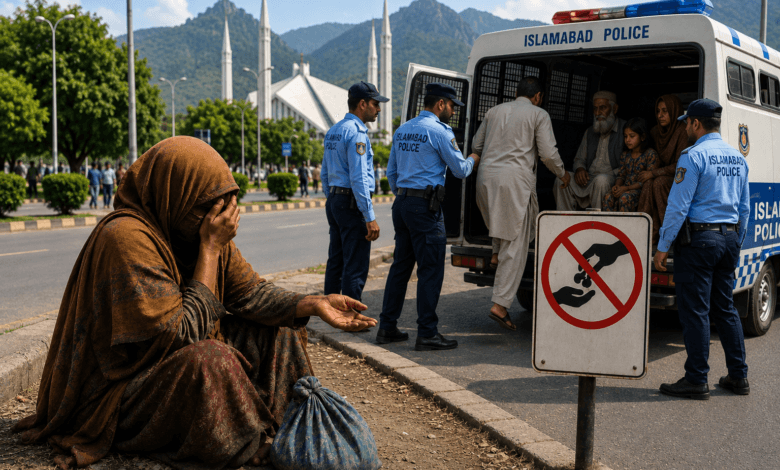
ISLAMABAD: Professional begging remains a persistent challenge in Islamabad despite repeated anti-begging operations conducted by the Islamabad Capital Territory (ICT) Administration, raising concerns over organised begging networks, the exploitation of vulnerable women and children, and the effectiveness of existing enforcement and rehabilitation efforts.
ICT Administration Continues Anti-Begging Campaign
According to official updates shared by the Deputy Commissioner Islamabad, the ICT Administration has continued its anti-begging campaign across the federal capital.
Official daily updates show that at least 310 professional beggars have been taken into custody in separate operations conducted across different parts of the city as of today.
Recent operations include:
- 22 professional beggars shifted to lockups during an operation in Blue Area, F-6 and F-7 on July 17.
- 24 professional beggars taken into custody during operations conducted a day later.
The administration also urged citizens to support the campaign by discouraging professional begging and avoiding direct cash donations.
Beggars Continue to Occupy Public Spaces
Despite repeated enforcement drives, beggars remain a common sight at:
- Major traffic intersections.
- Markets.
- Commercial centres.
- Places of worship across the federal capital.
Their continued presence has raised questions about whether enforcement alone is sufficient to address the problem.
Current Enforcement Framework
Anti-begging operations in Islamabad are primarily conducted by the ICT Administration through the Deputy Commissioner and Assistant Commissioners, while Islamabad Police assist in maintaining law and order and taking legal action where required.
Professional begging in Islamabad is currently addressed under existing anti-vagrancy and other applicable laws.
Proposed Anti-Beggary Laws
To establish a dedicated legal framework for the federal capital, the Islamabad Prevention of Beggary Bill, 2020 was introduced in the Senate.
The proposed legislation sought to:
- Prohibit organised begging.
- Penalise those who exploit vulnerable individuals for begging.
- Establish rehabilitation measures through certified institutions.
During deliberations by the Senate Standing Committee on Interior, lawmakers:
- Expressed concern over organised begging networks.
- Raised concerns about the exploitation of women and children.
- Recommended stronger legal safeguards against criminal groups involved in forced begging.
- Called for stricter measures to curb organised begging.
However, the bill did not ultimately become law.
A separate private member’s bill, the Islamabad Capital Territory Prevention of Beggary Bill, 2021, was later introduced in the National Assembly with similar objectives, including prohibiting begging and strengthening rehabilitation measures.
However, the bill did not complete the legislative process before the dissolution of the National Assembly and subsequently lapsed.
As a result, authorities continue to rely on the existing legal framework and administrative measures while conducting regular anti-begging operations across the capital.
Use of Surveillance and Intelligence
Authorities have also stated that:
- Safe City surveillance cameras are being used to identify individuals allegedly involved in organised begging networks.
- Intelligence-based operations are being conducted against organised groups.
Officials have previously maintained that:
- Some organised groups allegedly exploit women and children for begging.
- Certain individuals posing as beggars have also been linked to street crime.
These issues have highlighted broader public safety concerns associated with organised begging.
Human Rights Concerns
Research on internal human trafficking in Pakistan identifies forced begging as a form of exploitation, with women and children among the most vulnerable victims.
Human rights and child protection organisations have argued that individuals forced into begging should be treated primarily as victims requiring:
- Protection.
- Rehabilitation.
- Access to social services.
rather than punishment.
During discussions on the proposed anti-beggary legislation, lawmakers also expressed concern over the exploitation of children and called for stronger legal safeguards against organised begging networks.
Public Urged to Donate Responsibly
Authorities have repeatedly urged citizens not to hand cash directly to professional beggars, warning that indiscriminate donations may unintentionally sustain organised begging networks.
Instead, they encourage the public to donate through:
- Registered charitable organisations.
- Welfare institutions.
to ensure assistance reaches genuinely deserving individuals.
Socio-Economic Challenges
At the same time, social welfare organisations caution against treating everyone begging on the streets as part of organised criminal networks.
They note that the following factors continue to push many individuals towards begging:
- Poverty.
- Unemployment.
- Disability.
- Inflation.
- Other socio-economic hardships.
They highlight the need for a compassionate and evidence-based approach that distinguishes genuine need from organised exploitation.
Need for Long-Term Rehabilitation
Social welfare organisations and child rights advocates argue that while strict enforcement is necessary to dismantle organised begging networks, it must be complemented by broader social welfare policies.
They recommend:
- Expanding rehabilitation programmes.
- Improving access to education.
- Increasing vocational training opportunities.
- Strengthening child protection systems.
- Creating better employment opportunities for vulnerable communities.
They also stress that without effective rehabilitation and long-term social support, many individuals detained during anti-begging operations eventually return to the streets, limiting the long-term impact of periodic crackdowns.
A Lasting Solution Requires More Than Enforcement
As Islamabad continues to grow, tackling organised begging will require more than periodic crackdowns.
Sustained enforcement against organised begging syndicates, effective rehabilitation programmes, and broader social welfare policies are essential to protect vulnerable people while dismantling criminal networks that profit from exploitation.
While enforcement remains an important component of the government’s strategy, addressing the underlying socio-economic factors that drive vulnerable individuals towards begging is equally critical to achieving a lasting solution.