Silence That Speaks: How Electric Policing Is Driving Islamabad Towards a Greener Future
From electric police patrols to zero-emission public transport, Islamabad is quietly emerging as Pakistan’s most ambitious urban sustainability experiment—where environmental responsibility, fiscal efficiency and public service converge.

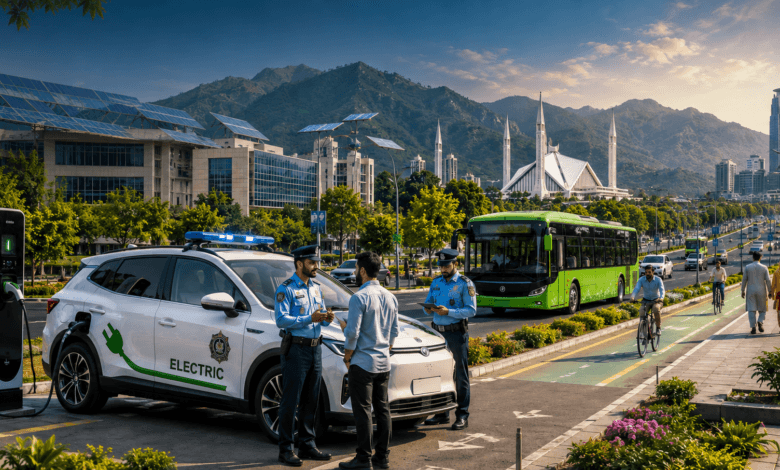
There was a time when the unmistakable roar of diesel engines defined the rhythm of Islamabad’s streets. Today, on many of the capital’s wide boulevards, that familiar sound is gradually being replaced by something almost imperceptible—the quiet hum of electric motors.
This transformation may seem subtle, but it represents one of the most significant shifts in Islamabad’s urban governance since the city’s inception.
The arrival of electric patrol vehicles in the Islamabad Police fleet is not merely the introduction of a new technology. It signals a broader change in mindset—one where environmental sustainability, economic efficiency and modern public service are no longer competing priorities but complementary objectives.
Cities around the world are rethinking mobility. Islamabad now appears determined to become part of that conversation.
Islamabad’s Growing Electric Police Fleet
According to official sources, Islamabad Police is adding around 80 new BYD electric vehicles to its Capital Patrol Unit (CPU), with approximately 40 allocated to the Islamabad Traffic Police. The induction expands the force’s electric fleet to roughly 120 vehicles, making it one of the largest electric police fleets in South Asia.
This is not simply a procurement exercise.
It is a policy statement.
The initiative reflects a wider commitment by the Islamabad Capital Territory (ICT) Administration to place sustainability at the heart of governance. Chairman of the Capital Development Authority (CDA) and Chief Commissioner Islamabad, Lt. (Retd.) Sohail Ashraf, has repeatedly emphasised that the administration’s long-term vision extends far beyond policing.
“Our ultimate mission for the entire ICT administration is to go green and achieve zero emissions,” he says. “We intend to push this sustainable agenda as far as possible across all of Islamabad’s public and municipal services.”
Those words carry weight because the transition has already begun.
Electric feeder buses now connect major destinations such as PIMS and the National University of Sciences and Technology (NUST), providing commuters with cleaner and quieter public transport. Urban planners are exploring the expansion of electric mobility into additional municipal services, signalling an ambition to build an integrated transport ecosystem powered increasingly by clean energy.
If sustained, this strategy could redefine Islamabad as Pakistan’s first genuinely green capital.
Beyond Environmental Symbolism
Environmental narratives often focus solely on carbon emissions, but the advantages of electric mobility extend much further.
For law enforcement agencies, operational efficiency matters just as much as sustainability.
The earlier pilot phase of Islamabad Police’s electric fleet demonstrated encouraging results. Official departmental assessments reported a satisfaction rate of nearly 98 percent among users, while projected savings indicated that the initial investment could recover its cost within approximately one year through lower fuel and maintenance expenses.
Police officials estimate that each electric patrol vehicle could reduce operating costs by nearly Rs550,000 per month compared with conventional petrol-powered vehicles.
In an era of tightening public finances, such savings cannot be ignored.
Every rupee saved on fuel can potentially be redirected towards:
- Officer training.
- Technology.
- Forensic capabilities.
- Community policing.
- Public safety initiatives.
Good environmental policy, therefore, also becomes good fiscal policy.
A New Generation of Policing
The practical benefits of electric patrol vehicles are equally compelling.
Electric motors operate almost silently, allowing officers to patrol residential neighbourhoods during late-night hours without causing unnecessary disturbance. That same silence can also improve surveillance and community policing, where discretion often matters more than visibility.
Equally important is performance.
Unlike conventional engines that require time to build momentum, electric drivetrains deliver instant torque. Rapid acceleration can make a meaningful difference during:
- Emergency responses.
- Highway patrols.
- Pursuits where seconds can influence outcomes.
Technology, in this case, enhances operational capability rather than merely replacing an engine.
The transformation is also reaching police leadership.
Sub-Divisional Police Officers (SDPOs) have begun using BYD Shark plug-in hybrid pickup trucks for inspections, field supervision and operational coordination, reflecting how electrification is gradually becoming embedded throughout the policing structure.
Infrastructure Matters More Than Vehicles
Electric vehicles alone cannot create a sustainable transport ecosystem.
Charging infrastructure remains the foundation upon which successful electrification depends.
Recognising this, Islamabad Police has established dedicated fast-charging stations across strategic locations in the capital, enabling patrol vehicles to recharge within roughly 60 to 90 minutes. Overnight charging at police facilities further ensures operational readiness while making efficient use of off-peak electricity.
The city’s public charging ecosystem is also expanding.
Collaborations involving:
- BYD.
- Hubco Green Energy.
- Pakistan State Oil (PSO).
have already resulted in fast-charging facilities becoming operational in commercial centres such as:
- I-8 Markaz.
- E-11.
These developments represent the early stages of a much broader transition.
Infrastructure is what transforms electric vehicles from isolated projects into a functioning urban ecosystem.
Learning from the World
Islamabad is far from alone in this journey.
Across the globe, governments are recognising that cleaner transport improves not only environmental outcomes but also economic resilience.
Examples include:
- China deploying thousands of electric police vehicles in cities including Shenzhen, Beijing and Shanghai.
- Police departments in India introducing locally manufactured electric SUVs.
- Singapore replacing conventional government fleets with electric alternatives.
- Dubai replacing conventional government fleets with electric alternatives as part of wider climate strategies.
Pakistan’s circumstances make the transition particularly relevant.
The country remains heavily dependent on imported petroleum products, exposing the economy to volatile international oil prices and placing persistent pressure on foreign exchange reserves.
Every electric government vehicle contributes—however modestly—to reducing that dependence.
Viewed collectively, such initiatives strengthen both environmental security and economic stability.
Challenges That Cannot Be Ignored
None of this suggests that the journey will be effortless.
Pakistan continues to face challenges related to:
- Electricity generation.
- Grid reliability.
- Charging accessibility.
- Battery recycling.
- Lifecycle management.
- Long-term maintenance expertise.
- Sourcing renewable electricity needed to maximise environmental benefits.
These issues deserve careful planning.
A green vehicle powered entirely by fossil-fuel-generated electricity cannot fully realise its environmental promise.
Future policy must therefore integrate electric mobility with:
- Renewable energy.
- Smart grids.
- Sustainable urban planning.
if Islamabad wishes to achieve genuine net-zero ambitions.
A Blueprint for Pakistan
Perhaps the greatest significance of Islamabad’s electric transition lies not in the vehicles themselves but in the precedent they establish.
Successful public-sector innovation often spreads.
If Islamabad demonstrates measurable improvements in:
- Operational efficiency.
- Reduced emissions.
- Financial savings.
other provincial capitals and municipal governments may adopt similar strategies.
Potential future applications include:
- Electric buses.
- Municipal vehicles.
- Waste management fleets.
- Ambulances.
- Administrative transport.
In that sense, Islamabad is serving as a testing ground for Pakistan’s urban future.
The Sound of Tomorrow
Cities are remembered not only for their skylines but for the choices they make.
The quiet hum now replacing engine noise across parts of Islamabad symbolises more than technological advancement. It reflects a changing philosophy of governance—one that recognises environmental stewardship, economic prudence and public service as interconnected responsibilities rather than separate ambitions.
The transition to electric mobility will not solve every urban challenge.
Cleaner transport alone cannot eliminate congestion, pollution or climate risks.
Yet meaningful change rarely arrives all at once. It often begins with small but deliberate decisions that gradually reshape institutions, infrastructure and public expectations.
On Islamabad’s roads, that future is already beginning to take shape.
And for perhaps the first time in Pakistan’s history, progress may be measured not by the roar of an engine, but by the quiet confidence of a city moving towards a cleaner, smarter and more sustainable tomorrow.