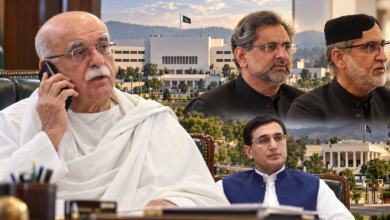
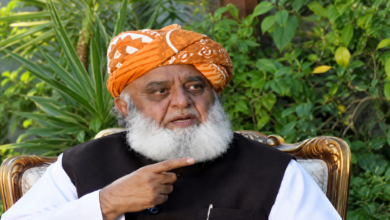
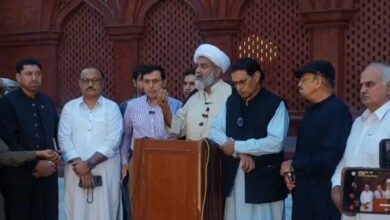
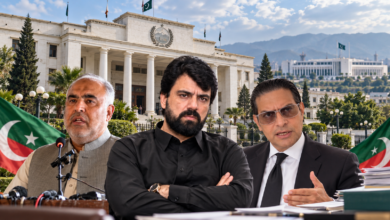
Khawaja Asif Warns Against Repeated Political Marches on Islamabad
Defence minister says federal government will use all lawful resources to safeguard Islamabad and describes Governor’s Rule in Khyber Pakhtunkhwa as a last-resort option, as PTI continues its political march and maintains that its mobilisation is peaceful and constitutional.


ISLAMABAD: Defence Minister Khawaja Asif said on Wednesday that the federal government would ensure the security of Islamabad under all circumstances, adding that all constitutional and legal options were being considered amid continuing political tensions surrounding the federal capital.
Governor’s Rule Called ‘Last Option’
Speaking to journalists at Parliament House in Islamabad on October 7, Asif said Governor’s Rule in Khyber Pakhtunkhwa remained a “last option” and that the government wanted to avoid reaching that stage. He said any final decision would depend on the evolving circumstances and the constitutional options available to the federal government.
Asif said the federal government could not leave the capital vulnerable to recurring political confrontations and argued that Islamabad could not be subjected to large-scale mobilisation every few months. According to him, the government had a responsibility to protect the federal capital and would employ available lawful resources if the security situation required it.
The defence minister also made allegations concerning links between elements of the Khyber Pakhtunkhwa government and the Taliban, while discussing what he described as potential security concerns surrounding the mobilisation towards Islamabad. The allegation was reported as Asif’s claim; the reports reviewed by Islamabad Tribune did not provide independent evidence establishing it as fact.
PTI Mobilisation Continues
His remarks come as Pakistan Tehreek-e-Insaf’s long march, led by Khyber Pakhtunkhwa Chief Minister Sohail Afridi, continues its movement through the province. The mobilisation began from Lakki Marwat on October 4 after an earlier September 27 date was postponed. By October 6, Afridi was leading the convoy from Kohat towards Mattani on the outskirts of Peshawar, with organisers saying the mobilisation was expected to move towards Khairabad before its next course of action was announced.
PTI, for its part, has repeatedly described its movement as a peaceful and constitutional political campaign. Party officials said participants had been instructed not to carry weapons, sticks, slingshots or stones, and maintained that the party intended to pursue its demands through political mobilisation.
The confrontation follows unsuccessful negotiations between government and opposition representatives aimed at resolving differences before the march. Talks at Parliament House ended without agreement, with the two sides publicly disputing responsibility for the deadlock. Reports identified access to imprisoned PTI founder Imran Khan and disagreements concerning counterterrorism policy in Khyber Pakhtunkhwa among the central issues.
Earlier, Chief Minister Afridi had also offered dialogue with the federal government, saying political disagreements should be resolved through mutual understanding. He has maintained that peaceful protest is a constitutional right and warned against any attempt to impose Governor’s Rule in the province.
What Governor’s Rule Means Constitutionally
The term “Governor’s Rule” is commonly used politically, but the relevant constitutional mechanism is contained in Article 234 of the Constitution, dealing with a failure of constitutional machinery in a province.
Under Article 234, if the president receives a report from the provincial governor and is satisfied that the provincial government cannot be carried on in accordance with the Constitution, a proclamation may be issued allowing specified provincial governmental functions to be assumed by the president or exercised through the governor on the president’s behalf. The Constitution also provides a parliamentary route where resolutions are passed by both Houses separately.
A proclamation under Article 234 is also subject to parliamentary approval and time limits. The constitutional text provides that it initially ceases after two months unless approved, while subsequent extensions are limited and the arrangement cannot continue indefinitely.
Therefore, Asif’s comments indicate that the option is being discussed at the federal level; they do not themselves constitute the imposition of Governor’s Rule, which would require the constitutional procedure prescribed under Article 234.
Political Situation Remains Fluid
The political situation remains fluid as PTI’s mobilisation progresses and both sides continue to publicly present sharply different accounts of the dispute. The federal government says protection of Islamabad and continuity of normal civic life are its responsibility, while PTI says its mobilisation represents the exercise of constitutional political rights.