DG ISPR Accuses Baloch Sardar Elite of Fueling Terrorism, Smuggling and Status Quo
Military spokesperson presents nationwide counterterrorism statistics, discusses Balochistan's security challenges, governance, Kashmir, and Pakistan's constitutional framework while outlining the state's security and development strategy.

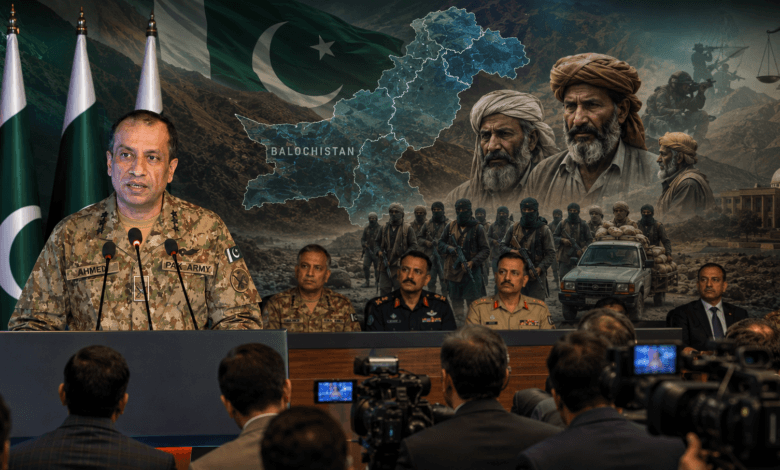
RAWALPINDI: Director General Inter-Services Public Relations (ISPR), Lieutenant General Ahmed Sharif Chaudhry, addressed a comprehensive press conference on Friday focusing on Pakistan’s counterterrorism operations, the security situation in Balochistan, constitutional obligations, governance, and the country’s position on Kashmir.
Counterterrorism Operations and Security Statistics
Opening the briefing, the DG ISPR said Pakistan continues to conduct extensive intelligence-based operations (IBOs) against terrorist groups across the country.
According to figures presented during the press conference:
- More than 34,800 intelligence-based operations have been conducted nationwide during the current year.
- 7,177 operations were carried out in Khyber Pakhtunkhwa.
- 31,080 operations took place in Balochistan.
- 2,091 operations were conducted in the rest of the country.
The military spokesperson stated that 3,145 terrorist incidents had occurred this year. He said 1,971 incidents were reported in Khyber Pakhtunkhwa and 1,971 incidents in Balochistan, while noting that the statistics reflected the concentration of militant activity in those regions as presented during the briefing.
He said security forces had eliminated 2,084 terrorists during operations this year, averaging approximately 10 militants killed daily.
Regarding sacrifices made during counterterrorism operations, he stated that 819 people had embraced martyrdom, including:
- 303 Pakistan Army personnel
- 394 members of law enforcement agencies
- 322 civilians
He added that Pakistan had witnessed 28 suicide attacks during the year.
Afghan Nationals and Cross-Border Terrorism
The DG ISPR alleged that, similar to the previous year, suicide attackers involved in incidents this year were Afghan nationals.
He specifically referred to attacks in Tank and Karachi, alleging Afghan involvement, and claimed evidence recovered during military operations pointed towards individuals holding Afghan nationality.
He further alleged that the Afghan Taliban administration was providing support to terrorist organisations operating against Pakistan.
Constitutional Responsibilities Before Rights
A significant portion of the briefing focused on constitutional responsibilities.
The DG ISPR said Pakistan’s Constitution applies equally to every citizen and stressed that while citizens often discuss their rights, equal attention must also be given to constitutional obligations.
He said every citizen has a constitutional duty to remain loyal to the state, uphold the Constitution, and place Pakistan above ethnic, tribal or regional identities.
“Our first and last identity should be Pakistani,” he said, adding that rights and responsibilities must go hand in hand.
Quoting remarks made recently by the Field Marshal during a workshop in Balochistan, he said discussions in society frequently focus on rights but rarely on responsibilities. He suggested that public awareness campaigns should also encourage citizens to fulfil their constitutional duties.
He further remarked that, “If there is a state, then there is politics; if there is a state, there is life and identity.”
Balochistan and the Sardari System
Turning specifically to Balochistan, the DG ISPR described the sardari system as the province’s fundamental challenge.
He clarified that his criticism was directed not at every tribal elder, but at a section of the elite who, according to him, seek to preserve the existing status quo.
According to the DG ISPR, these influential figures oppose educational and economic advancement for ordinary Baloch citizens because such progress would weaken their traditional influence.
He alleged that they do not want children from poor families to become doctors, engineers, military officers or professionals, preferring instead to maintain dependency.
He described this mindset as believing that such elites possess only rights while bearing no responsibilities toward society.
The DG ISPR further alleged that these elements form one of the principal drivers behind terrorism in the province.
Allegations Against Certain Sardar Elites
The military spokesperson made a series of allegations against sections of the tribal elite.
He claimed some individuals regarded the Levies Force as their personal militia, influencing recruitment and salary distribution for personal benefit.
According to him, these individuals expected large numbers of Levies personnel to provide security to themselves and their families rather than serve the public.
He also alleged that some were involved in smuggling operations involving:
- Narcotics
- Fuel and diesel
- Cross-border illegal trade
He claimed these activities generated enormous profits while contributing to insecurity.
The DG ISPR alleged that when authorities moved against these networks, those responsible attempted to increase violence and then argued that security conditions required renewed political negotiations.
He quoted what he described as their approach:
“If you stop us, we will increase terrorism, then claim the situation is out of control and demand negotiations.”
He stated that the state would no longer follow such an approach.
“No more. You are not the stakeholders,” he said.
Instead, he said the government would engage directly with the people of Balochistan, whom he described as the province’s genuine stakeholders.
He added that public funds should benefit ordinary citizens rather than influential families.
External Influence
The DG ISPR identified external power play as another major factor affecting Balochistan.
He alleged that hostile foreign actors were attempting to destabilise the province while supporting terrorist organisations.
He also said there was no meaningful distinction between “Fitna al-Hindustan” and “Fitna al-Khawarij,” arguing that both ultimately sought to destabilise Pakistan.
Security Operations in Balochistan
The military spokesperson praised the role of Balochistan Police, Frontier Corps (FC), Counter Terrorism Department (CTD), and other law enforcement agencies.
He highlighted several attacks that he said had been successfully repelled, including:
- The Kachhi attack of 27 October 2025, involving 40–45 terrorists.
- The Quetta attack in January, during which DSP Faisal Rashid, Inspector Zubair, ASI Mahmood-ur-Rehman and Constable Arshad Faheem embraced martyrdom.
- The 30 March attack on Kotla Police Station in Jhal Magsi, foiled by FC and police.
- Simultaneous attacks on Kalat and Khaliqabad police stations.
- The 24 April attack on Dhadar Police Station, where police, FC and Anti-Terrorist Force personnel repelled militants despite casualties.
- The 8 June Khuzdar police station attack, which he said was defeated through coordinated action by police and FC.
He praised the bravery of officers and personnel who lost their lives defending public institutions.
Development and Public Engagement
Alongside security operations, the DG ISPR emphasised development initiatives.
According to him:
- Around 10,800 students receive IT training annually in Balochistan.
- 703 open public forums (Khuli Kacheris) have been organised across the province.
- Public complaints raised during these meetings are officially recorded and followed up.
He contrasted this approach with what he alleged was the preference of militant groups and certain elites, saying they wanted young people carrying weapons, whereas the state wanted them carrying laptops and tablets.
Governance
Responding to questions regarding governance, the DG ISPR said improving governance remains essential.
He argued that Pakistan’s population has increased dramatically since 1972, while the administrative structure has largely remained unchanged.
He suggested policymakers should examine whether existing governance arrangements adequately serve a population now exceeding 250 million.
He added that all political parties seek improvements in governance and administration.
Kashmir
Concluding the briefing, the DG ISPR reaffirmed Pakistan’s longstanding position on Jammu and Kashmir.
He stated that Pakistan and Kashmir are inseparable, describing Kashmir as Pakistan’s “jugular vein.”
He said Pakistan would continue supporting the Kashmiri people and alleged that India had deployed nearly one million security personnel in the region.
He claimed movement restrictions, detentions and security measures had failed to diminish pro-Pakistan sentiment among Kashmiris.
The DG ISPR also accused India of attempting to undermine Pakistan through incidents such as Pulwama and Pahalgam, alleging these were used to advance anti-Pakistan narratives.
Referring to political developments in Azad Jammu and Kashmir, he said disputes over representation should be addressed through constitutional and democratic processes rather than violence, emphasising that the state’s monopoly over the use of force remains a constitutional principle.