Federal Constitutional Court Overturns Monal Demolition Order, Sends Ownership Dispute Back to Trial Courts
The court accepted appeals filed by the CDA and Islamabad’s metropolitan administration, vacated the stay order and directed trial courts to decide competing ownership and financial claims independently; the ruling does not, by itself, establish Monal’s ownership rights or guarantee its immediate reopening.

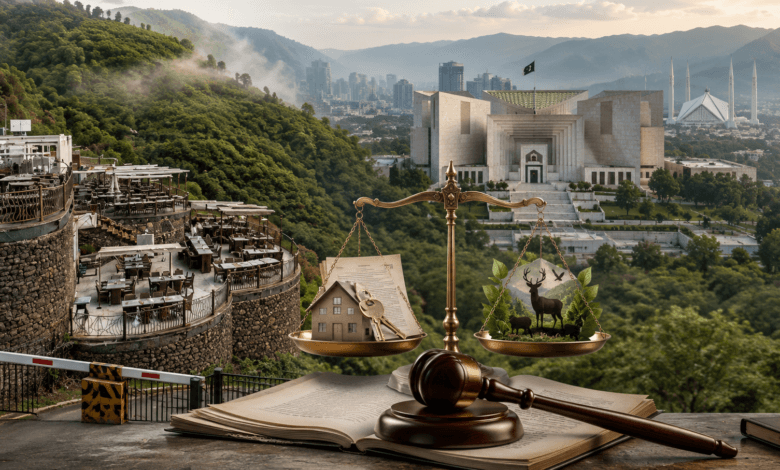
ISLAMABAD: The Federal Constitutional Court has set aside the earlier judicial direction for the demolition of the Monal Restaurant complex at Pir Sohawa, accepting appeals filed by the Capital Development Authority and Islamabad’s metropolitan administration in a significant development in the long-running dispute over commercial activity inside the Margalla Hills National Park.
According to the order announced by the court, the existing stay was also vacated, while the parties’ competing claims concerning ownership, possession, lease rights and financial liabilities were sent back to the relevant trial courts for determination.
The Constitutional Court directed the trial courts to decide the pending cases at the earliest and without being influenced by observations contained in earlier judicial proceedings.
It further ruled that questions falling within the administrative jurisdiction of public bodies should be determined by the competent regulatory authorities under the applicable laws.
Demolition Order Set Aside, but Ownership Remains Unresolved
The judgment alters the legal basis on which the physical structures associated with Monal and neighbouring establishments were facing demolition. However, it does not appear to conclusively declare Monal the lawful owner or lessee of the disputed site.
Instead, the court separated the different dimensions of the controversy: civil courts will determine ownership, possession and contractual rights, while regulatory institutions will decide environmental, municipal and administrative matters falling within their respective jurisdictions.
The practical future of the premises will therefore depend on the outcome of the civil litigation, regulatory approvals and the detailed terms of the Constitutional Court’s written judgment.
The decision should consequently not be interpreted as an automatic order for the immediate reopening of the restaurant. During an earlier hearing on June 11, 2026, the Constitutional Court had declined a request for Monal’s immediate reopening while examining the legality of the Supreme Court’s 2024 ruling.
Court Questions Scope of Previous Judgment
During the latest proceedings, Justice Syed Hasan Azhar Rizvi observed that several material aspects had not been sufficiently considered in the earlier Supreme Court decision.
“We are not going to make an emotional decision,” Justice Rizvi was quoted as saying, stressing that the matter had to be decided on the basis of the record and applicable law.
The judge also remarked that, after examining the earlier ruling, the bench found that a considerable amount of material beyond the actual court proceedings had apparently been incorporated into the judgment.
When counsel Ahsan Bhoon praised the bench for studying the case thoroughly, Justice Rizvi responded that lawyers should not praise the court and that the bench would issue only the order justified by the proceedings before it.
“We will not write an Alif Laila story in the judgment,” Justice Rizvi remarked, indicating that the court intended to restrict its findings to the legal issues and material formally placed before it.
The three-member bench hearing the matter was earlier reported to comprise Justice Syed Hasan Azhar Rizvi, Justice Rozi Khan Bareech and Justice Syed Arshad Hussain Shah.
Local Government’s Financial Claim
Islamabad’s local government had challenged the earlier decision closing and demolishing Monal, arguing that the judgment adversely affected its proprietary and financial interests.
According to the review petition, Monal owed Rs63,955,895 — approximately Rs63.96 million — in rental or lease-related dues.
The petitioner also claimed that money deposited by Monal before the court had been transferred to the Islamabad Wildlife Management Board despite, in the local government’s view, the board having no legal entitlement to the amount.
It maintained that the disputed rental and lease proceeds belonged to the local government and were required for municipal services in Islamabad, including services for local villages situated within or around the Margalla Hills National Park.
The local government contended that the previous ruling had deprived it of legitimate financial resources that could otherwise have been spent on sanitation, infrastructure and other municipal responsibilities.
These assertions remain claims contained in the review proceedings and will require adjudication by the competent courts or authorities. The Constitutional Court’s decision to remit ownership and related disputes to trial courts means the monetary claim has not necessarily been finally established against Monal.
How the Controversy Began
The Monal dispute emerged from competing claims by the CDA, Islamabad’s municipal administration, the Remount Veterinary and Farms Directorate, the Islamabad Wildlife Management Board and the restaurant operators over control and use of the Pir Sohawa site.
In June 2024, the Supreme Court ordered restaurants operating inside the Margalla Hills National Park, including Monal, to relocate within three months. The court treated leases and commercial allotments inside the protected national park as incompatible with the Islamabad Wildlife Protection Ordinance and the ecological status of the area.
The Supreme Court subsequently directed that Monal and the neighbouring La Montana Restaurant be closed. The establishments ceased operations in September 2024 following the court’s order, which had been presented as a measure to protect the biodiversity and ecological integrity of the national park.
Review petitions against the original directions were also considered in 2024. At that stage, the Supreme Court rejected challenges to the vacation order, observing, among other things, that Monal’s operators had earlier agreed to vacate the premises.
Constitutional Court Reopened Legal Questions
The dispute later came before the Federal Constitutional Court through review proceedings pursued by the CDA and local government authorities.
At hearings in June 2026, the federal government supported reconsideration of the demolition direction. Its counsel reportedly argued that the earlier judgment was not legally sustainable, particularly when numerous other structures continued to exist within the protected area.
The court also questioned whether the earlier proceedings had adequately addressed:
- Civil ownership disputes.
- The role of trial courts.
- Subsequent wildlife legislation.
- The legal authority of different government entities.
Counsel appearing in the case argued that the civil litigation should be allowed to proceed and that the parties’ rights should not be conclusively determined through observations made outside the ordinary trial process.
Environmental Protections Remain a Separate Question
Although the demolition order has now been set aside, the judgment does not necessarily remove environmental restrictions governing commercial activity inside the Margalla Hills National Park.
The park’s protected status, the legal powers of the Islamabad Wildlife Management Board and the authority of other regulatory institutions remain relevant. Any proposed reopening, reconstruction, leasing arrangement or commercial use may still require approval under environmental, wildlife, building-control and municipal laws.
The earlier Supreme Court judgment was centred on the principle that commercial activity and construction inside a protected national park could damage its biodiversity and ecological character.
The Constitutional Court’s latest approach appears to distinguish those regulatory concerns from civil questions of ownership and entitlement. This means a party may succeed in establishing a property or contractual interest before a trial court but still be subject to environmental restrictions imposed by the competent regulator.
What Happens Next
The detailed written judgment will be critical in determining the exact extent to which the previous Supreme Court directions have been displaced.
The relevant trial courts will now be expected to decide the ownership, possession, rental and lease disputes independently. Regulatory bodies will separately consider questions involving land use, wildlife protection, environmental compliance and any permissions required for commercial operations.
Until those proceedings are completed, Monal’s legal and operational future remains unresolved despite the removal of the demolition direction.
The ruling provides substantial legal relief against the immediate destruction of the premises, but it does not conclusively settle who owns the land, who is entitled to the disputed rental income or whether restaurant operations may lawfully resume inside the national park.